






































Notary Public: This Pending PhD-
Darling Buds-
The Global Pedagogy Journal Exodus 2021-
- Examples are the Ur-
III dynasty's experiment in a centrally managed economy, the ancient Eastern traditions of the Usury- Frayne, 1997).Laws and debt- relief edicts, and the Israelite priests' Jubilee program and related populist policies ( - The Economic theory suggests that these hierarchical interventions, when effective, would have impaired the evolution of customary land institutions and reduced overall welfare. In sum, in the boldest of strokes, the ancient record tends to support the relative efficacy of civil society and both the necessity for, but utter unreliability of, the state. These generalizations have implications for the remaining two schools of theory of historical evolution. Stage theorists, such as Marx and Weber, have sought to discern regular historical progressions. The history of the ancient Middle East does reveal cross-
cultural trends, for instance the movement toward greater land alienability. But stage theory implies more static and dynamic regularities than the evidence supports.
Recorded events of land institutions in Hebrew Mesopotamia did not show the monolithic land-
There is no collection of laws from ancient Egypt, unlike Sumerian, Akkadian, Hittite and Babylonian law collections, and to make it even more difficult the ancient Egyptians used everyday language regarding their legal concepts. It is important to note that the transfer of personal and landed property from one owner to another was known. Documentary evidence in funerary inscriptions confirms that private property did indeed exist and that it was transferable, with equality between husband and wife in the eyes of the law. When the Persians conquered Egypt, the fundamentally Egyptian institutions, based on the individual, were revived. Tradition attributes a new codification of the existing laws to Darius. Under the Ptolemies in the second century BC, judgment was given in a matter regarding conflicting interests in a succession, with the procedure, although adapted, still retaining several elements of the old tradition. Law was a living entity and therefore did not remain unchanged over the centuries; it changed because human aspirations, conditioned by new circumstances, necessitated change. This change evolved between the poles of equality and liberty on the one hand and that of inequality on the other. What is striking about ancient Egyptian law is its modernity. Although remote in time, it furnished the ancient Egyptian civilisation with a structure close to that with which we are familiar today. The application of law was coherent despite peculiar features of procedure. Certain fundamental elements of ancient Egyptian law appear to be, among others, the great importance of justice as well as the value that was attached to tradition both important to maintain the bigger order of things.
Finally, we must recognize that the Hebrew’s skills and dreams of freedom were invested in ancient Egypt. They acted as slaves, and the skilful labour force which designed and built the Pyramids, they also acted as advisors for the Pharaohs who worked within the maat, and aiming the promised freedom that materialized on the events of Moses. The Hebrew were the spinal cord of the evolve Egypt civilizations.
2.1.3 Law of Maat
Although sources of law in the Old Kingdom (2613 -
- decrees regarding administration
- decrees regarding tax exemptions
- endowments of offerings
- endowment decrees for immovable property
- decrees for appointments
- stipulations for the benefit t of private individuals, and
- other issues, such as, the letters
The main sources of law in the Middle Kingdom and the Second Intermediate Period, dated (2040-
2.1.4 Jurisprudence
The archives and documents of legal content are for leasing and land holdings contracts in ancient Egypt. Tomb biographies, of (12th Dynasty), also have statements referring to legal matters and administration. Texts initially written on papyrus were inscribed on temple or chapel walls, to provide security to the legal documents. Texts from the Middle Kingdom, such as the Tale of the Eloquent Peasant and the story of Sinuhe include legal material. Then, the New Kingdom documents are concerned with sales, loans, leases, disputes, litigation, marriage, adoption, partnerships and inheritance. Most of this material derives from Thebes in southern Egypt, while other documents, like the Legal Text of Mes are from Memphis in the north of Egypt and contain references to court disputes, confirming the existence of government archives. The lexical texts that were found comprise a mixture of paragraphs with some appearing to be excerpts from a law code while others apparently derive from clauses in standard contracts. This mixture of law-
Middle Kingdom archives and documents of their legal content are for leasing and land holdings contracts. Tomb biographies, of (12th Dynasty), also have statements referring to legal matters and administration. Texts initially written on papyrus were often inscribed on temple or chapel walls, obviously to provide security to the legal document. Texts from the Middle Kingdom, such as the Tale of the Eloquent Peasant and the story of Sinuhe include legal material, and in a passage from. The New Kingdom documents are concerned with sales, loans, leases, disputes, litigation, marriage, adoption, partnerships and inheritance. Most of this material derives from Thebes in southern Egypt, while other documents, like the Legal Text of Mes are from Memphis in the north of Egypt and contain references to court disputes, confirming the existence of government archives. The lexical texts that were found comprise a mixture of paragraphs with some appearing to be excerpts from a law code while others apparently derive from clauses in standard contracts. This mixture of law-
According to Manning the so-
According to Theodorides, ancient Egypt does not present an example of the secularisation of law. On the contrary, however, it attained from the onset (during the Old Kingdom) a high level of institutional and juridical development. It is known that classical writers, such as Diodorus, wrote respectfully of law and justice in ancient Egypt, and law-
2. ANCIENT EGYPT, LAW OF
2.1 Legal System, Structure of
The Pharaoh was the representative of Gods, and their divine justice system presides at the top of the ancient Egyptian Judicial hierarchy. This was followed by a Vizier, and the courts which were firmly consolidated under the king's vizier (An ancient Greek System). The Law or order was governed by religious principles, and the Law was believed to be handed down to mankind by the gods on the moment of creation. Gods were held responsible for establishing and perpetuating the law. Thus, no Egyptian code of law has been found, which corresponds to Mesopotamian Codes of Ur-
Code of Pharaoh must have existed because precedent in deciding legal cases was set by the events of the Early Dynastic Period (3150 -
Egyptian law was based on the central cultural value of ma’at (harmony) which had been instituted at the beginning of time by the gods. In order to be at peace with oneself, one’s community, and the gods, all one had to do was live a life of consideration, mindfulness, and balance in accordance with Maat. Inscriptions in tombs and on stelae and papyri indicates that Egyptian law ranks with Sumerian as the world’s oldest surviving legal system and its complexity and state of development are on a level with ancient Greek and medieval law.
The law at the regional level was quite simple but became more bureaucratic during the Old Kingdom. Even so, at this time, judges were often priests who conferred with their god to reach a verdict rather than weighing the evidence and listening to testimonies. It was only during the Middle Kingdom that professional judges were installed to preside over courts and the judicial system operated on a more rational, recognizable paradigm. This period also saw the creation of the first professional police force which enforced the law, took suspects into custody, and testified in court. Since the law was founded on so simple a divine principle, and since it seemed clear that adhering to that principle was beneficial to all, transgressors were often punished severely.
Although there are certainly cases of leniency shown to criminal suspects, the operative legal opinion was that one was guilty until proven innocent, since otherwise, one would not have been accused in the first place. There was a set of agreed-
Ancient Egyptian culture flourished through adherence to tradition and their legal system followed this same paradigm. Basic laws and legal proscriptions were in place in Egypt as early as the Pre-
2.1.1 Theological Background
The emergence of ancient Egyptian law is out of religion, and arising from the concept of Maat. In many instances the Law also emerged separately due to the effects of Greek Culture. Religion was present in every aspect of the Egyptians’ life; rather than being a separate category. The law stood above all humans and was personified by the goddess Maat, with the concept of maat representing truth, justice, righteousness, the correct order and balance of the universe. Egyptian law was essentially based on the concept of maat, which was about morality, ethics and the entire order of society. The goal of maat was to keep the chaotic forces at bay, with the idea of order as the Grundlage of the world, upon which the legal system was based in turn. The ancient Egyptians saw no difference between human and divine justice, and Maat represented a sense of moral responsibility.
2.1.2 Law in Ancient Egypt
The indigenous ancient Egyptian were ruled mainly by the ancient Greek, and adapted to their evolve civilization that was based on theological order. The skills and labours (dynamo) were of Hebrew origin. This was the envy of the barbaric Persians who invaded Egypt at later stages. Thus, ancient Egypt was governed by religious principles and the Egyptian law was based on a common-
The term Law emerged as a mechanism to maintain maat on earth with the king playing an important part by making law. The Pharaoh was the supreme judge, who was in a position to transform the belief in maat (man-
It would appear that the king, the vizier (equivalent of prime minister) and the great courts located at Memphis had jurisdiction over crimes against the state. The king was the head of the judicial administration, and yet no evidence survives from the Old Kingdom to suggest that the king could hear and decide cases himself, neither that was the logic of the events. The purpose of law in ancient Egypt was to realise maat on earth and the king was the link between law and maat. Kingship in ancient Egypt represented the effective power of the order of maat. Therefore, Maat was the means of the Egyptian Pharaohs to act as an absolute Monarch of dictatorship nature. Theodorides question whether one can talk about law before its elaboration by the Romans, since there is a lack of documentary evidence.
Law #142: If a woman quarrels with her husband, and say: You are not congenial to me the reasons for her prejudice must be presented. If she is guiltless, and there is no fault on her part, but he leaves and neglects her, then no guilt attaches to this woman, she shall take her dowry and go back to her father's house.
ix. Adultery, Law #129: If the wife of a man has been caught lying with another man, they shall bind them and throw them into the waters. If the owner of the wife would save his wife then in turn the king could save his servant (Benjamin, 2001).
x. Perjury, Law #3: If a man has borne false witness in a trial, or has not established the statement that he has made, if that case be a capital trial, that man shall be put to death (see section 15.1-
1.2.2 Law, Lex-
System Lex-
1.2.3 Law, Cuneiform of
Dyneley, 1904; Eichler, 1987; Finkelstein, 1970; Goetze, 1951; Speiser, 1963; Westbrook, 1985 and Yaron, 1988 wrote about Cuneiform as a system of writing invented by the ancient Hebrew Sumerians, and used in the Mesopotamia in the last three millennia B.C. It includes the laws of the majority of the inhabitants of the ancient Middle East, especially the Sumerians, Babylonians, Assyrians, Elamites, Hurrians, Kassites, and Hittites who, despite many ethnic differences, were in contact with each other and developed similar civilizations. In certain periods this cultural community was reinforced by the diffusion of Hebrew Akkadian, a diplomatic and scholastic language written in cuneiform. Thus, cuneiform is a scientific necessity, because no other term covers all, and only these laws. Mesopotamian law, for example, captures only part of the range of laws involved, and the notion of ancient Middle Eastern law is too vast, for it also includes both Judaic law and Egyptian law, which were separate developments (though a relationship between biblical law and cuneiform law may exist). The various collections of cuneiform laws developed by the several nations and kingdoms have certain features in common, such as:
- The text of several collections contains a prologue and an epilogue in which the prince emphasizes the importance of his actions, explains the object of his work, and commands its observance by blessings or threats.
This may occur beyond the age limits, and to be claimed by Monarchists after 99-
b. Rational-
c. Stage theorists, aspire to identify sequences in institutional change when e.g. Karl Marx and other leading intellectuals became engrossed with ancient civilizations. They developed theory of historical progression based on underlying property relations and ruling classes, envisages a transition in late prehistory from a primitive tribal to communism, or reductionist work envisioned a succession of stages: in the past-
d. Cultural pluralists, anthropology and sociology stress differences among societies and epochs and the dangers of generalizing across them. This perspective is represented within the legal academy. The Critical Legal Studies movement have tended to emphasize the mutability and contingency of human institutions. While ideology, language, and class structure influence institutions, and may shed light on the plausibility. Instead, the objectives are:
- publicize to a wide academic audience a trove of material about land institutions at the dawn of history, to offer the ultimate in time-
series of data. - analyze this material from a law-
and- first it assumes that 5,000 years is too brief a span for significant genetic evolution; second law and economics employs rational-economics perspectives. This approach involves a set of methodological assumptions that should be made explicit: actor model of human behavior.
This model anticipates that law-
- The optimistic has a dynamic-
dimension. As land became scarcer, technology advanced, and literacy spread, these ancient civilizations tended to develop more efficient land- sale procedures and tended to relax traditional restraints on alienation that were ill- adapted to an urbanizing economy. These innovations hardly occurred smoothly or in predictable stages. - The pessimistic assessment is consonant with public-
choice theory. In the ancient Middle East, a powerful hierarchy (state, temple, or conquering invader) commonly imposed plainly inefficient land institutions. While the ancient state could earn legitimacy by providing a variety of public goods, it also introduces counter productive measures that would enrich well- positioned constituencies at the expense of those less powerful.
- Although written as if inspired by the gods, the legislation is secular, composed of dispositions fixed and codified by the temporal lord.
- Although the laws may derive from different sources custom, judicial decisions, or deliberate legislation the fact that they are introduced by the prince gives them all the character of legislation or enactment.
- In contrast to modern codes, these ancient codes do not systematically treat all the rules applicable to a given area of law; that is, they treat a variety of matters but often ignore many highly important rules, simply because such rules were grounded so deeply in custom that they went unquestioned.
- Because legal customs were generally known, the collections focused on explaining individual cases, using them as examples or precedents, and did not attempt to present general, abstract formulas; and
- Because of this absence of doctrinal intent, the arrangement of cases seems erratic, often defies modern reasoning (Finkelstein, 1970).
The most ancient legislator known is Ur-
1.3 Law, Biblical Order of
Ellickson and Thorland (1955) concluded their pedagogic endeavour of rule-
- Did the ancient Middle East generate the marble cakes of land arrangements?
- How does the evidence, on land regimes, assembled with alternative conceptions?
The Peoples of the ancient Middle East grappled with comparable issues some 3,000 years before the English Normans did learn the principles from the Old-
a. Rational-
1.2 Law, Hammurabi Code of
The Hebrew King Hammurabi (6th Hebrew king, origin of Star-
Thereafter, the Hebrew (12-
________________________________________________________
4 Second Hebrew Code-
5 see section 15.1 definitions; Code-
6 see section 15.1 definition; Torah, New Testament and Quran.
1. MESOPOTAMIA, LAW OF
1.1 Law, Ur-
The first Hebrew civilization of Kingships God-
(1) the earlier Hebrew rulers acted Kingship of Gods, then Hebrew Abram of Mesopotamia acted Patriarch Abraham of the One-
The Code of Ur-
____________________________________
1 Missing codes may refer to the hidden code @ Babylon, and damaged code(s) may refer to inaccurate readings. The first Hebrew code of Casuistic Rule of Nature (The Artific code ≡ IF (Crime), THEN (Punishment), using monetary compensation, with no Gandhi rule (i4i mean all go blind), and no Rule-
2 see section 15.1 definition; Ḫašḫamer
3 One mina (1/60 of a talent ) was made equal to 60 shekels (1 shekel = 8.3 grams, or 0.3 oz.).
Thereafter, the Roman’s took over the illusive rule-
1.2.1 Ethics, Orders of
The Hebrew invented the demand of the need of the present ethics of civilizations and progressed the order from the Code of king Ur-
i. Slander, Law #127: If any one 'point the finger' at a sister of a god or the wife of any one, and can not prove it, this man shall be taken before the judges and his brow shall be marked (i.e. cutting the skin, or perhaps hair).
ii. Fraud, Law #265: If a herdsman, to whose care cattle or sheep have been entrusted, be guilty of fraud and make false returns of the natural increase, or sell them for money, then shall he be convicted and pay the owner ten times the loss.
iii. Slavery (slaves as property), Law #15: If any one takes a male or female slave of the court, or a male or female slave of a freed man, outside the city gates, he shall be put to death.
iv. Theft, Law #22: If one committed robbery & caught, then he shall be put to death.
v. Duties of workers, Law #42: If any one takes over a field to till it, and obtain no harvest there, it must be proved that he did no work on the field, and he must deliver grain, just as his neighbor raised, to the owner of the field.
vi. Trade, Law #104: If a merchant give an agent grain, wool, oil, or any other goods to transport, the agent shall give a receipt for the amount, and compensate the merchant therefore, he shall obtain a receipt from the merchant for the money that he gives the merchant.
vii. Liability, Law #53: If any one be too apathetic to keep his dam in primly condition, and does not so keep it; if then the dam break and all the fields be flooded, then shall he in whose dam the break occurred be sold for money, and the money shall replace the crops which he has caused to be ruined.
viii. Divorce, Law #128: If man take a woman to wife, but have no intercourse with her, this woman is no wife to him.
Pre-
This clause lists, on html only, chronicles of root of Rule-
- In the their administration of justice the Egyptians also showed no merely casual interest, holding that the decisions of the courts exercise the greatest influence upon community life.
- By appointing the best men from the most important cities as judges over the whole land they did not fall short of the end which they had in mind;
- Allowances to provide for their needs were supplied by the king to the judges sufficient for their maintenance, and many times as much to the chief justice. The latter regularly wore suspend from his neck by a golden chain a small image made of previous stones, which they called Truth. Diodorus's description here appears to describe accurately the so-
called Great Courts in the urban centers of the New Kingdom, the chief judge no doubt referring to the Vizier himself. The necklace with the symbol of Ma'at is known (ISSN: 1740- 9527, 2012).
2.2.7 Justice, Court of
The most important public representation of justice came in civil trials that occurred in a highly charged, symbolic, indeed dramatic, location the temple gate. Temples in Egypt were the living embodiment of order, of Ma'at. They were not churches in any modem sense, a place for private worship. Rather, they were institutions of the state, places of state ritual, and public festivals that ordinary people could observe. Gates represented the nexus between the outer world of chaos and the interior world of cosmic or divine order and truth. During the Ptolemaic period (305-
2.3 Crime & Punishment
Infidelity in ancient Egypt was considered a serious offense only if the individuals involved made it one. A husband whose wife had an affair could forgive her and let the matter go or he could prosecute. If he chose to take his wife to court, and she was found guilty, the punishment could be divorce and amputation of her nose or death by burning. An unfaithful husband who was prosecuted by his wife could receive up to 1,000 blows but did not face the death penalty. As the nuclear family was considered the basis for a stable community, adultery was a serious offense but, again, only if those involved brought it to the attention of the authorities or, in some cases, if a neighbor informed against them, and no lawyers in ancient Egypt. In the Pharoahs court of ancient Egyptian, a person who had been charged was guilty until proven innocent, so witnesses are often beaten to make sure they were telling the truth.
This same model seems to have been followed in other areas as well. It was the duty of the family to provide tomb offerings for their deceased loved ones and, if they did not have the time, they could hire someone else to do it. These replacements were known as ka-
2.2.1 Justice, Despotism of
Ancient Egypt may be traced from Athens to Rome into Medieval Europe. Egyptian conceptions of justice and the evidence of the adjudication of legal disputes during the Ptolemaic period (305-
2.2.2 Private Justice
The concept of law and justice are intimately associated with the proper behaviour of kings and were embedded in every royal ritual. Ordinary people were also governed by the same concept. Proper behaviour was expected in all relationships, within the family, between neighbours, between officials and the governed. A text of the second century BC instructed, so that when we travel round the country they do not present us with petitions concerning wrong-
Despite the fact that such Books of the Dead were reserved for the burials of the very wealthy, such sentiments and the fear of a last judgment must have been a part of the wider Egyptian society as ancient stories depict.' Private moral behaviour, living by Ma'at, was expected throughout Egyptian society. The same kind of official behaviour is expressed in the Duties of the Vizier, recorded in a couple of private tombs of viziers of the New Kingdom (1550-
2.2.5 Public Justice
Justice is what held the world together, and it did so by connecting consequences with deeds. Justice linked human action to human destiny, and wedded individuals to community. For the ancient Egyptian, justice refers to a life of harmony with the connective structures that make community possible, both with one's fellows and with the gods. Representations of justice, and the adjudication of disputes in courts, were as much a part of the public and private spheres in ancient Egypt as they were in ancient democracies. In Egypt, however, there was public authority, namely the king. It was the king, through piety toward the gods and benevolence toward men, who guaranteed justice. One of the most important rituals of the king during the New Kingdom was the offering of Ma'at, a public statement, depicted on temple walls, of the exchange between the gods and the king, a royal guarantee of maintaining order, justice, and political stability. The concepts are also well known in the Egyptian literary tradition of seeking justice as well as the opposite, the advent of chaos, in the absence of a good king. The concept of Ma'at and the world of divine judgment permeated the representation of justice and trials in the real world. The king was the source and the center of positive law and the guarantor of social norms in towns and villages across Egypt. Although most disputes, and the writing of contracts, were in the hands of local officials and local scribes, the right to petition the king directly was always a feature of Egyptian law, which rarely reached the king himself. It was in the hands of local officials to resolve disputes of private wrongs, expectations of Ma'at.
2.2.6 Public Trials
Adjudications of disputes before courts were public and monumental occasions for the representation of justice. As elsewhere, Ma'at, connective justice, was on display in the courts. We know something of the structure of ancient Egyptian courts particularly from later sources. Diodorus Siculus, writing in Greek during the first century BC, expressed admiration for Egyptian law. Although his analysis is likely a composite account of the organization of courts, and the nature of judges, it does preserve an authentic tradition of Egyptian jurisprudence:
The land was divided between them by their father (ISSN: 1740-
2.2.3 Connective Justice
Ma'at may refer in the ancient Egyptian connective means to justice, or order, cosmos, truth; or a social contract. Ma'at was the mirror of the divine order of the world and also the foundation of private ethical behaviour. Ma'at was the most persistent and pervasive idea in ancient Egyptian society. Egypt has never been discussed as having the concept-
2.2.4 Justice, Morality of
The most visible image of Ma'at is in a private context is the famous last judgment scene, in which an individual faced his or her mortality by having his or her life deeds weighed in the balance against the symbol of justice, the ostrich feather, in front of all of the gods in Egypt. If a person is found wanting, the person's soul was devoured and his or her existence was extinguished. If a person is found true of voice, one gained eternal bliss in the after life. This was not the public representation of state justice, but, rather a more intimate depiction of the expectations of private moral behavior. This scene is dramatically portrayed in the well-
2.1.4.1 Justice, Balance of
Maat subordinated the social order to a broad concept of equity, and since the ancient Egyptians had a well-
2.1.4.2 Justice, Traditions of
The coherent entity of the ancient Egyptian civilisation spans almost forty centuries of unchanging stability and that the ancient Egyptians were conservative and tradition-
- first instance, judges kept records of their legal decisions in the archives of the vizier in order to consult them later as precedent; and
- secondly, because of the admiration for tradition, the law was slow to evolve.
The law probably changed and developed over a long period of time, and in the ancient Middle East different conditions existed, and the basic features of law did not undergo any radical changes for a very long period. In the Old Kingdom, the king was in supreme control of legislation, and laws were conceived as expressions of ideal justice. A law promulgated remained in force as long as it was not modified or repealed. The judges, officials or parties responsible for the law did not read the law in the same way as we do today, and there was no interpretation of the exact wording of a text, since it was not regarded as autonomous or exhaustive.
General decrees could be divided into three main areas, namely constitutional law, administrative law and law concerning economic activities. In the ancient Middle East references to decrees attest to their existence, although they are not citations of the texts. The closest the early sources came to citations were the references to actions or decisions being in accordance with the words of the stele or tablet. According to Westbrook (1985 and 2003), it would appear that statutes, orders and decrees, dealt with specific matters of immediate interest, and that they did not establish a source of the basic principles of law in a court. The majority of the law would have been customary in nature and is it here that the law codes, either in the written forms that we possess or as a larger oral canon from which the extant codes were drawn, could serve a vital function. The achievement of these law codes was to constitute an intellectualisation of the mass of information that would have constituted customary law in the ancient Middle East. Westbrook states that there is evidence that previous decisions were regarded as a source of law, and that most of the law applied by the courts was probably customary law which derived from timeless tradition. Thus, legislations included all orders issued by the king, his officials or local authorities. Ancient Middle East orders were rather (ad hoc) commands, regarding right-
2.2 Legal System, Admin of
In ancient Egypt, the administration system of the law was known as the seru, the kenbet, and the djadjat (see footnotes 8-
_________________________________________
8-
It was also possible for victims or families of victims to intervene in the execution of a sentence. If they chose to forgive the perpetrator, his death sentence was removed and he would become a slave of the victim’s family.
- Theft was considered a serious crime. Capital offenses included theft from merchants, theft from a temple, theft of arms or military insignia, and theft of more than 20 ears of corn. Petty theft was generally punished through restitution. If the perpetrator wasn’t able to pay for the stolen item, he became the victim's slave.
- Adultery was a capital offense for the guilty couple and for those who were aware of the offense and failed to report it. Men were punished for adultery only if they had relations with a married woman. Married women were considered guilty regardless of circumstances of marital status of lovers.
- Public drunkenness was punishable by death for younger individuals. However, elders could consume as much alcohol as they wished.
- Children under the age of ten were considered to be legally incapable of committing criminal acts, but were still expected to respect and obey their parents. If they failed to do so, their parents could bring them before the court, which could order punishments such as beatings, disinheritance, or death (especially if children assaulted their parents). Children of nobility were sentenced to death if they were disrespectful, cowardly, or wasteful.
3.8 Aztec Property Law
The Aztecs had a complex and hierarchical land ownership system, and drew sophisticated boundary maps that were used to mark different types of land and settle disputes. The Emperor owned personal and royal property which was used as he saw fit. He additionally exercised dominion over newly conquered lands, and could give this land to nobles, warriors, and calpulli. Owners of conquered lands were not necessarily displaced and were usually allowed to continue living on and working their lands. However, they had to share the profits of the land with their new Aztec owners. Nobles could own land on a restricted and unrestricted basis. Nobles obtained land by purchasing it from other nobles or as a gift from the emperor for service to the Aztec empire. Purchased land could be sold or willed. Land grants from the emperor sometimes had conditions that required them to be returned to the emperor upon the death of the owner. Warriors had similar rights to purchase land or receive it from the emperor. Institutions such as the army, temples, and certain public offices (judgeships) could also own land which was received from the Emperor. These entities owned the rights to the profits from the land and used them to support the office holder. However, the individual office holder did not own the land. Commoners could not own land on an individual basis. However, they had access to land through their calpulli. Although the calpulli were run by nobles, members of the calpulli were permitted to elect a neighborhood leader (calpullec) to manage the distribution of communally-
3.12 Texcocan Law
Texcoco was founded in the 12th century and grew to prominence within the Aztec Empire in the early 15th century through its leader, Nezah-
3.13 Maya Law
Maya: (noun) a member of an American Indian people of Yucatan, and Central America (Oxford Dictionary). The ancient Maya civilization existed for over two thousand years before the arrival of the Spanish conquistadores in the 16th century. The ancient Maya settled in Central America, southern Mexico, and the Yucatan peninsula, and are believed to have been connected to the northern areas of Mesoamerica through their trading activities. The history of the Maya civilization does not follow a straightforward path. Maya cities and regions advanced, collapsed, and had varying levels of influence at different time periods. The Classic Period from 250 – 900 AD is considered to have been the height of the ancient Maya civilization. During this time period, the Maya were led by dynastic rulers, the population grew dramatically. The art and culture flourished, the elite classes became more entrenched, and wars and demands for tribute occurred more frequently. However, by the end of the Classic Period, the Maya kingdoms had begun to splinter and break off into smaller states. When the Spaniards arrived in the 1500s, the peak of the Maya civilization was long over and the remaining Maya states tended to be less centralized and more commercially oriented. The Yucatec Maya first encountered the Spanish in 1502, but the official conquest of this region did not begin until 1527. The Maya fought with the Spaniards for several years until the conquest was completed in 1542. Despite the abuses that occurred during the Spanish colonization of the Maya homeland and the unfortunate human rights violations that continue to impact this region today, the Maya culture has survived and the modern day indigenous Maya of this region continue to carry on many of the traditions of their ancestors.
3.14 Maya Political Structure
The Ancient Maya shared a similar ideology and worldview, but they were never united as a single empire. Instead, the Maya lived in individual political states that were linked together through trade, political alliances, and tribute obligations. Some of these states were independent, while others were part of larger political hierarchies. The Maya states were initially governed by simple chiefdoms. By the Classic Period, Maya governance had taken on the form of powerful centralized leaders who legitimized their authority through their political connections and their divine lineages. Individuals who disobeyed their rulers faced severe punishment because the Maya people believed that obedience to their leader was critical to maintaining the harmony of the Maya universe. Human sacrifice had begun prior to the Classic Period, and was used as a tool of social and religious control to demonstrate the power of the ruler and the gods. At the time of the Spanish conquest, the Yucatan was divided into 18 separate Maya states, with many smaller towns and villages under the jurisdiction of a capital city. Nine of these states were ruled by a single ruler called a halach uinic (or ahaw), while the others were led by councils of nobles of elite lineage or were allied with larger states. The halach uinic’s power was limited by his council (holpop) and special military and foreign advisors, but he was still considered to be the highest authority in his state and was required to be from an elite lineage. Rulers were succeeded by their sons, brothers, or a suitable candidate who was selected by the priests and council if no relatives existed.
3.9 Aztec Commercial Law
The main sources of income for the empire were tribute and taxation. The conquered regions paid tribute to the emperor and the Aztec citizenry paid taxes (with the exception of priests, nobles, minors, orphans, invalids, and beggars). Merchants paid taxes on the goods that they sold, artisans paid taxes based on the value of their services, and barrios paid taxes through the crops that they produced. Failure to pay taxes was punishable through slavery or the confiscation of property. Tribute was collected as a collaborative effort by the members of the Triple Alliance every 80 days, 6 months, or 12 months, depending on the goods being collected and the distance that they had to travel. Tribute items typically included warrior costumes and shields, tropical feathers, copal incense, paper, foodstuffs, and animal products. Official tribute collectors, known as calpixque, were located in each of the conquered provinces and ensured that payments were made as required. Researchers have observed that tribute payments were generally reasonable, and were only increased if a region reneged on its tribute obligations. Regions that failed to pay tribute were severely punished. Merchants were extremely important to the Aztec empire, especially traveling merchants known as pochtecah who ventured into neighboring regions. Pochtecah were organized into their own calpulli and could pass their profession and land down to their children. They had their own guilds, laws of conduct, and courts to enforce their laws. They ventured into foreign regions to establish trade and sometimes served as messengers and spies for the Aztecs. Merchants who were attacked while on the road were expected to defend themselves, and were sometimes assisted by warriors. War was justified if the safety of an Aztec merchant was threatened. Local commerce was required to be carried out in large marketplaces known as Tianquiztli. The various marketplaces were open once a week on rotating days, although the largest market in Tlatelolco was open on a daily basis. The marketplaces were patrolled by special commissioners who worked to prevent fraud and disturbances. Commercial disputes were settled in the marketplaces through special commercial courts that had the power to impose capital punishment if necessary. Sales were made on cash and credit. While there was no official currency, various goods functioned as money, including cacao grains, small squares of cotton cloth, small nuggets of gold, pieces of tin, and precious feathers. The Aztecs used contracts to carry out their business activities. Contracts were formed verbally and became legal and binding when witnessed by four people. There is evidence to suggest that the Aztecs had sales, commission sales, lease, work, and loan contracts. Loan contracts used collateral in the form of property, goods, or future slavery if a default occurred. Interest on loans was illegal, although there is evidence to suggest that it was charged. A debt could be passed on to a party’s heirs, and loan defaults resulted in jail, slavery, or the confiscation of property.
3.10 Aztec Family Law
Aztec family law followed customary law. Men got married between the ages of 20-
Aztec families could live in single family homes, though many opted to live in joint family households for economic reasons. Aztec families were very close knit. Children were considered gifts from the gods, but were expected to be obedient to their parents and elders. Parents were permitted to physically punish their children, and would beat them using maguey spines or force them to inhale chili smoke. Children who became orphaned lived with aunts and uncles or other family members. Fathers were responsible for raising their sons, and educated them until they began school. Mothers took care of raising the girls in the family. There was no divorce, but men and women could petition the courts for legal separation on the basis of incompatibility, misconduct by the wife, insanity by the wife, abuse by the husband, laziness by the wife, infertility, or financial debt. Courts generally tried to encourage reconciliation where possible. Simple abandonment of a household by one party was also sufficient to establish a legal separation. Once the couple separated, the sons went to live with their father and the daughters stayed with their mother. Property registered at time of marriage was returned to the party who brought it to the marriage. If there was a guilty party in the marriage, the offender forfeited half of the community property to the other spouse. Divorced and widowed parties could get remarried. Widows had the option of marrying their husband's brother as well. There is some conflicting information among researchers regarding inheritance rights. According to Avalos, women had no inheritance rights and the first born son inherited all property from his father. A trustee would be appointed if the heir was still a minor. If there were no male children, property was passed on to the Middleest male relatives, and if no male relatives existed, the property went to the state. However, Avalos acknowledges that a father could create a will as he saw fit, with property conceivably going to his wife or daughters. According to Kellogg, men and women could both acquire property through inheritance, though the right of women to inherit property may have been limited by the fact that the deceased’s brother would usually act as a guardian of the estate.
3.11 Aztec Military Law
The Aztec empire was strongly militaristic and its relations with other territories typically revolved around war. The Aztecs conquered neighboring regions in order to collect tribute and obtain captives for human sacrifice. War was justified when a territory closed its roads to commerce, when a merchant or ambassador was killed, or if a territory refused to pay its required tribute. A ritual was followed for declaring war. The Aztec Emperor would issue a declaration of war and envoys were sent to the enemy region. The enemy was given a gift of weapons and 20 days to respond to the declaration and submit to Aztec authority. If no agreement was reached, the enemy was brought another gift of weapons and given another 20 days to respond. If no agreement was reached after this second offering, a third and final warning was given with harsher terms. If no agreement was reached after the final warning, the Aztec army would attack within twenty days. Enemy kings suffered personal punishment by the Aztecs if they waited until the third warning to accept the Aztec empire's terms. During combat, captured warriors were enslaved and sacrificed. Captives had the option of fighting Aztec warriors in order to obtain their freedom and would be forced to fight with a handicap, such as with one hand tied behind their backs. If the captured warrior won the fight, he would be set free. The Aztecs also engaged in what were known as flower wars. These wars were conducted to provide warriors with battle training and to obtain human sacrifices for religious ceremonies. Human sacrifice was important to the Aztecs and was done to appease the gods and maintain the balance of life in the universe. Most sacrificial victims were warriors captured in battle. To be sacrificed was an honor because it was believed that this would guarantee life after death (Aguilar-
The cihuacoatl was the second in command after the tlatoani, was a member of the nobility, served as the supreme judge for the court system, appointed all lower court judges, and handled the financial affairs of the altepetl. New emperors were elected by a high council of four nobles who were related to the previous ruler. Emperors were usually chosen from among the brothers or sons of the deceased ruler. They were required to be nobles, to be over the age of 30, to have been educated at one of the elite calmecac schools, to be experienced warriors and military leaders, and to be just. Although the emperor had absolute power and was believed to be a representative of the gods, he governed with the assistance of four advisors and one senior advisor elected by the nobility.
3.4 Aztec Social Structure
The Aztecs followed a strict social hierarchy in which individuals were identified as nobles (pipiltin), commoners (macehualtin), serfs, or slaves. The noble class consisted of government and military leaders, high level priests, and lords (tecuhtli). Priests had their own internal class system and were expected to be celibate and to refrain from alcohol. Failure to do so would result in serious punishment or death. The tecuhtli included landowners, judges, and military commanders. Nobles were entitled to receive tribute from commoners in the form of goods, services, and labor. Noble status was passed on through male and female lineages, and only nobles were permitted to display their wealth by wearing decorated capes and jewelry. The commoner class consisted of farmers, artisans, merchants, and low-
The Aztecs had various special jurisdiction courts, including commercial courts (which handled marketplace and merchant disputes), family courts, fiscal affairs courts, a military court, and a religious court (which handled cases concerning priests, students, and religious matters). The Aztecs additionally had neighborhood courts that were similar to modern justices of the peace. Judges were elected by the neighborhood to hear minor criminal and civil cases, and reported their decisions to the Tecalli courts. These judges also had a police force to serve summons and arrest criminals. Aztec judges were viewed with great respect and honor, and were expected to be impartial, ethical, and honest. The Emperor (or tlatoani) appointed the Cihuacoatl, who in turn appointed all of the lower court judges except for the neighborhood judges. Judges were appointed for life and could be removed only for misconduct. Judges received their training through an apprenticeship program that involved observing court proceedings. Future judges were then selected from among the apprentices. The judiciary was self-
3.7 Aztec Criminal Law
Under the Aztec legal system, crimes were severely punished. While capital punishment was common, other punishments included restitution, loss of office, destruction of the offender’s home, prison sentences, slavery, and shaving the offender’s head. For certain crimes, punishment could extend to the family of the guilty party. These crimes included theft, treachery, and a priest’s violation of the rule of chastity. The Aztecs had a prison system, which included the cuauhcalli (death row), the teilpiloyan (debtors’ prison), the petlacalli (prison for minor crimes), and a fourth type of prison which involved a judge drawing lines or placing sticks on the ground and ordering the prisoner not to cross them. Conditions in the petlacalli were so harsh that many prisoners died while in custody. Numerous offenses were punishable by death, including homicide, perjury, rape, abortion, highway robbery, moving boundary markers, serious defamation of character, destruction of crops, selling stolen property, weight and measure fraud, witchcraft, incest, official graft, pederasty, inciting a public disturbance, sedition, treason, desertion or insubordination by soldiers, use of the emperor’s insignia, and serious judicial misconduct. Capital punishment could be carried out through hanging, drowning, stoning, strangulation, beheading, disembowelment, burning, quartering, and opening the chest to remove the perpetrator's heart.
3.5 Aztec Legal System
The Aztec legal system was highly complex and was designed to maintain social order and respect for government institutions. Aztec laws were based on royal decrees and on customs that had been passed down from generation to generation. These laws were also interpreted and applied by Aztec judges in the various court systems. Aztec judges were not necessarily bound by existing law, and had some discretion to do what was just and reasonable under the circumstances. The concept of stare decisis did apply in certain situations, as punishments ordered in certain cases were typically applied to subsequent similar cases. The major civil and criminal laws were written down in pictograph for use by judges, while other customary laws were passed down to younger generations through spoken hymns. At the time of the conquest, the Aztecs had just begun to codify their laws into a more formal written form. However, the Spanish missionaries deliberately destroyed the few written court and legal records that existed because they were considered to be heretical. Other legal manuscripts were burned by Spanish troops for fuel, or were allowed to rot from humidity and neglect. As a result, the limited information that is available about the Aztec legal system comes from Spanish chroniclers and troops who documented their observations during the two years before Tenochtitlan was conquered. Many Spanish priests also studied the Aztecs during the years immediately following the Conquest, and wrote manuscripts known as codices. These codices discussed Aztec history, religion, natural history, warfare, political affairs, and the events following the Conquest. The best work was the 12 volume General History of the Things of New Spain, which was also known as the Florentine Codex. Written by Fray Bernardino de Sahagún, this work was based on interviews with Aztec elders who survived the Conquest, and includes detailed information about Aztec daily life, merchant and artisan business practices, and the governance of the Aztec empire. Because this codex provides a relatively pro-
3.6 Aztec Judicial System
The Aztec judicial system was made up of multiple courts with differing levels of jurisdiction. These included the trial courts, appellate courts, and a supreme court. The trial courts were known as Teccalli courts, and heard civil and criminal cases involving commoners. Civil judgments by this court were considered final, but criminal sentences could be appealed. The appellate courts, known as Tlacxitlán, reviewed criminal appeals from the Teccalli courts and served as trial courts for cases involving nobles and warriors. The Aztec Supreme Court reviewed decisions from the Tlaxitlán. The Chief Justice, or Cihuacoatl, determined the final verdict and his decision could not be appealed to the Emperor or the other judges. If the Cihuacoatl decided that a case was too important for the Court to rule on alone, it was sent to the Emperor, who held court every 12 days and rendered final judgments with the assistance of four elder noblemen. The Emperor retained the ultimate right to intervene in cases or appeals that were of importance to him or to the empire.
This method of administering justice allowed for numerous abuses, since cases were now being heard by a priest hiding in a statue rather than an officially appointed judge in a court of law. Although Egypt would see some bright moments in the return to law and order throughout the later periods, the legal system would never again function as efficiently as it had during the periods up through the New Kingdom, The Ptolemaic Dynasty (323-
2.5 Conclusion of Egyptian Law
In conclusion of justice system in ancient Egypt, there are dramatic differences between the classical world and the Egyptian in how justice was portrayed. In the Egyptian setting, a public trial was set before the awe-
2.4 Legal System, Regression of
The problem of false witnesses was not so prevalent in the early centuries of the civilization but became more frequent with the decline of the Egyptian Empire and a loss of faith in the concepts which had regulated Egyptian society and culture for thousands of years. The belief in the primacy of ma’at began to break down when the pharaoh (Ramesses III, 1186-
3. AZTEC & MAYA, LAW OF
3.1 Introduction
Aztec: (noun) a member of the American Indian people dominant in Mexico before the Spanish conquest of the 16th century (Oxford Dictionary). To limit the scope, sections 3.3 – 3.11 forward brief picture about the Aztec judiciary system. Sections (3.13-
3.2 Aztec Civil Order
The term Aztec refers to the seven indigenous tribes who share the common language of Nahuatl and who settled in the Valley of Mexico prior to the Spanish conquest. These tribes, which include the Xochimilca, Chalca, Tepaneca, Colhua, Tlahuica, Tlaxcalteca, and Mexica, began migrating to the Valley of Mexico from their legendary homeland of Aztlan in the early 12th century. The Mexica were the last of the tribes to arrive in the Valley in approximately 1250 AD. According to legend, the Mexica established their homeland in 1325AD on an island in Lake Texcoco where they found an eagle on top of a prickly pear cactus (as had been prophesied by one of their priests). They named their island city Tenochtitlan. As the Mexica consolidated their power, Tenochtitlan became the capital of the Aztec Empire. Tenochtitlan formed a strategic alliance with the neighboring Aztec city-
3.3 Aztec Political Structure
- The Aztec empire was made up of a series of city-
states known as altepetl. Each altepetl was ruled by a supreme leader (tlatoani) and a supreme judge and administrator (cihuacoatl). The tlatoani of the capital city of Tenochtitlan served as the Emperor (Huey Tlatoani) of the Aztec empire. The tlatoani was the ultimate owner of all land in his city- The tlatoani were required to be from the noble class and of royal lineage. Once a tlatoani was selected, he served his city-state, received tribute, oversaw markets and temples, led the military, and resolved judicial disputes. state for life.
5. ANCIENT INDIA, LAW OF
Law in India primarily evolved from customary practices and religious prescription to the modern well codified acts and laws based on a constitution. Though the recorded history of law starts only in the Vedic period, it is widely believed that ancient India had some sort of legal system in place even during the Bronze Age and the Indus Valley civilization. The various stages of evolution of Indian law were classified as that during 1: Vedic period, 2: Islamic period, 3: British period and 4: post independence. Hindu law refers to the code of laws applied to Hindus, Buddhists, Jains and Sikhs in British India (Musyoka 2010). Hindu law may also refer to the legal theory, jurisprudence and philosophical reflections on the nature of law discovered in ancient and medieval era Indian texts. It is one of the oldest known jurisprudence theories in the world (Davis, 2006). Hindu tradition, in its surviving ancient texts, does not universally express the law in the canonical sense of ius or of lex (Rocher, 1978). The ancient term in Indian texts is Dharma, which means more than a code of law, though collections of legal maxims were compiled into works such as the Nāradasmṛti (Arti, 2002).
The term Hindu law is a colonial construction (Bilimoria, 2011), and emerged after the colonial rule arrived in South Asia. In 1772, the British colonial officials decided that European common law system would not be implemented in India. The Hindus of India would be ruled under their Hindu law, and Muslims of India would be ruled under Muslim law called Sharia (Gaborieau, 1985). This divide-
In colonial history context, the construction and implementation of Hindu law and Islamic law was an attempt at legal pluralism during the British colonial era, where people in the same region were subjected to different civil and criminal laws based on the religion of the plaintiff and defendant (Griffith 1986, and Rudolph & Rudolph 2000). This legal pluralism divided the Indian society, and that Indian law and politics have ever since vacillated between legal pluralism of the notion that religion is the basic unit of society and different religions must have different legal rights and obligations, and legal universalism the notion that individuals are the basic unit of society and all citizens must have uniform legal rights and obligations. Herein, we may expect that no code of Rule-
_________________________
12 https://www.cbseacademic.in/web_material/doc/Legal_Studies/XI_U3_Legal_Studies.pdf; Ret. Nov 2019
13 See Oxford Dictionary.
Many of these theories in philosophy found their way into practice in Roman legal texts, including a remarkable body of law known as the jus gentium, or law of people or law of nations; sometimes described as Rome's greatest contribution to history Based on the principles of natural law, it recognized certain universal duties and rights that extended to all human beings as members of the world community as a whole. In Constantinople, poised between Europe and Asia, the Eastern Roman Empire prospered, especially after Emperor Leo III (685-
Their purpose is 'to restrain the ability of the wicked to inflict harnl.58 The fact that a manmade law existed, in other words, did not mean that it was necessarily just. An unjust law might have the appearance of law in the way that it was created and enforced, but it might actually be a perversion of law and no longer a law, if it did not meet these standards.
Very much like Mencius in ancient China and philosophers in classical Greece and Rome, Aquinas reinforced the radical idea that if laws were not just, then people had the right to disobey them. This concept would lay a foundation for the subsequent development of theories of natural rights, and those who eventually campaigned on behalf of human rights against tyranny and oppression would seize upon it. The Roman and Anglo-
However, most religions have applied the Lex-
In fact, the legal universalism and legal pluralism (of the notion that religion is the basic unit of society), do exist in the reality of shadow of the illusive Newton Time. This manifested itself by the level of Gandhi’s manipulation of the principle of coder Lex-
6. ROME & GREECE, LAW OF
Mencius in China, and Greek philosophers began their independent initiatives to consider the broader origins and meanings of law itself. They knew of the practical contributions iliat-
The great Roman statesman, Orator, philosopher, and legal scholar Marcus Tullius Cicero (106-
No more, in my opinion, should that law be considered just which our interrex passed [a bill creating unlimited powers], allowing the Dictator to execute with impunity any citizen he wished, even without trial. There is one, single, justice. It binds together human society and has been established by one, single law. Justice is completely non-
__________________________
14 Cyrus: (noun) King of Persia (559-
Boys were sent to live in community dormitories, but would return home each day to work with their fathers. It is not known whether boys received educational training at the dormitories or whether any formal schools existed. There is evidence to suggest that children were selected to be apprenticed for priests, artists, masons, etc. This selection was based on social status and aptitude. Women were trained to manage their households, though some worked outside the home as midwives, market vendors, and matchmakers. Noble wives and mothers participated in various rituals related to the ruling class, and there is some evidence to suggest that women may have had governing roles within the various Maya states. Inheritance property typically passed from father to son.
There is also evidence that certain professions, titles, and government offices were passed down from father to son, brother to brother, or uncle to nephew. Women did not have the legal right to inherit property, but could inherit the family’s debts and slavery status. If a man died without a son, property would pass to the deceased’s brothers. If the sons were young when they received their inheritance, a trustee was appointed to manage the property and use the proceeds of the property to support the sons. This was usually one of the brothers of the deceased. Once heirs reached adulthood, they would receive what remained of inheritance. War was a common occurrence throughout the history of the ancient Maya, and was conducted for the purpose of destroying rival states, gaining tribute, and capturing victims for human sacrifice. The halachuinic was considered the supreme military leader and was assisted by the nacom, a military adviser who was elected to this post every three years. When wars were declared, the batab was responsible for providing troops from his town to be sent to battle. However, it is not known how these troops were organized, trained, or supplied. During combat, nobles who were captured were immediately sacrificed.
Other captured soldiers were forced to become slaves and were sometimes treated in a humiliating manner by the conquering army. Wars typically did not last for a long duration, and the Maya did not destroy cities because this could adversely affect their ability to collect tribute from the conquered regions. Very little is known about foreign relations between the Maya and the Aztecs, though it is understood that the two regions engaged in trade and that the Aztecs collected tribute from certain Maya regions. It is not clear whether the Maya had nobles who served as ambassadors for their states and managed foreign relations with the Aztecs and other indigenous groups.
Recent archaeological work suggests that law in China antedates the life and thought of the seminal thinker Kongfuzi (spelled Kong Fuzi, “Grand Master Kong”), or, as he is known in the West by his Latinized name, Confucius (551–479 BC).
Yet Confucianism the thought of Confucius as transcribed by his disciples and elaborated over the centuries is central to an understanding of pre-
In the words attributed to Confucius in the collection of sayings known as Lunyu in Chinese and as the Analects in English. Suspects and criminals were arrested by the county police or the post-
Finally, all criminal cases were heard first in the court of the district in which the facts occurred. The magistrate investigated the facts, determined guilt or innocence, and then proposed the sentence for the offence as prescribed by the code. It was necessary to forward the case to the next superior court in the hierarchy, that of the prefect, for rehearing. The prefect's decision was final only in cases of penal servitude. Cases of exile or death were automatically reviewed by the provincial governor. All homicide cases and all cases attracting the death sentence were sent to the capital for review by the highest judicial tribunal, the Board of Punishments. No sentence of death could be implemented, except in extreme circumstances, without the emperor’s approval. Finally, no code of Rule-
____________________________
11 https://www.britannica.com/topic/Lunyu; Ret. Nov. 2019
4. ANCIENT CHINA, LAW OF
Chinese law refers to the body of laws in China and including institutions of administration. The term encompasses both the legal history of China prior to the foundation of the People’s Republic of China in 1949 and the law of China. Traditional Chinese Judiciary refers to the laws, regulations and rules used in China up to 1911, when the last imperial Qing dynasty fell. It has undergone continuous development since at least the 11th century BC. This legal tradition is distinct from the common law and civil law traditions of the West, Hindu law, and contrary to the concepts of contemporary Chinese law. It incorporates elements of both Legalist and Confucian traditions of social order and governance. Chinese criminal procedure was an inquisitorial system where the judge, the district magistrate, conducts a public investigation of a crime, rather than an adversarial system where the judge decides between attorneys representing the prosecution and defense. The Chinese despised the role of advocate and saw such people as parasites who attempted to profit from the difficulties of others. The magistrate saw himself as someone seeking the truth, not a partisan for either side. Under the supervision of Tang Confucian minister Fang Xuanling, 500 sections of ancient laws were compiled into 12 volumes in the Tang Code, which lists the five forms of corporal punishment. Leniency applied according to the Eight Deliberations of Blood relation; Motive for the crime; Virtue of the culprit; Ability of the culprit; Past merits; Nobility status; Friendship; and Diligent character. The Chinese term for law is (Fǎ) which refers to norm or model, and (lǜ) refers to statute. China has the following orthodoxies:
1-
2-
The Confucian view of law was centered on morality. Xun Zi, an early Confucian thinker, saw the necessity for legislation, but emphasized equally the importance of virtue on the part of the legislator and judiciary. There was a conviction that maintenance of the Confucian moral prescriptions through the apparatus of the state was essential for the preservation of a civilized society. Encouragement of the virtue of filial piety helped to strengthen the related duty of respect and submission to imperial authority. The codes signal their moral orientation by placing right at the beginning of the General Principles' section a description of the offences known as the Ten Abominations. These offences were regarded as the most abhorrent. As the official commentary of the Qing code states: persons guilty of any of the Ten Abominations destroy human bonds, rebel against Heaven, go against reason, and violate justice.
Witnesses were required to testify under oath and there is evidence to suggest that the parties were represented by individuals who functioned as attorneys. Batabs would review the evidence, evaluate the circumstances of the case, consider whether the criminal act in question was deliberate or accidental, and would order an appropriate punishment. Decisions made by the batabs were final and could not be appealed, though the victims could pardon the accused, thus reducing their punishment. If the accused parties were found guilty, their sentences were carried out immediately by the tupiles. The Maya did not have prisons, but may have had wooden cages that were used as holding cells for individuals who were awaiting capital punishment. If a crime occurred that affected an individual in another town, the batabs in the two towns would work together to ensure that issue was resolved. The batab generally acted independently, but would consult with the halach uinic on serious cases before passing judgment. Because the ancient Maya civilization had peaked before the Spanish Conquest, the amount of primary material on the Maya legal system is limited. The majority of Maya manuscripts and codices were destroyed by Spanish priests, and the surviving codices tend to focus on Maya astronomy, mathematics, history, calendars, and religious rituals. These include the Dresden, Paris, and Madrid Codices. Following the conquest, Maya scribes wrote various books, including the Popul Vuh, and the Books of Chilam Balam (Books of the Jaguar Shaman). Both of these resources contain information about Maya history, myths, and religious traditions. The conquistadores and Spanish missionaries additionally documented their observations of the Maya.
3.17 Maya Criminal Law
Under the Maya legal system, punishments for various crimes were severe. Murder, rape, incest, treachery, arson, and acts that offended the gods were punishable by death. However, the Maya distinguished between intentional and accidental acts. For example, individuals who were found guilty of homicide were sentenced to death. However, if a killing was accidental, the perpetrator was ordered to pay restitution or sell one of his slaves to the victim’s family. If the perpetrator was a minor, he would be ordered into slavery. Theft crimes were punished with restitution or temporary enslavement. The sentences of slavery and restitution were not limited to the perpetrator, but were also passed on to his family members. Maya homes were subject to special protection because they did not have doors. Individuals who entered homes to cause damage or injure others were sentenced to death. Nobles who were found guilty of crimes were treated especially harsh and were forced to have their faces permanently tattoed as a symbol of their crimes. Adultery was considered a criminal offense. Married women who committed adultery were publicly shamed and their lovers were stoned to death. Their husbands had the option of leaving the marriage and finding a new spouse. Married men who committed adultery were sentenced to death unless their extra-
Each of the Maya states had a supreme military commander called a nacom. The nacom served a three year term and was responsible for formulating military strategy and calling troops to battle. The individual states also had a high priest who led a hierarchy of priests, determined the dates for festivals and ceremonies, and foretold auspicious events for the ruler. The halach uinic appointed the batabs, who were the overseers and administrators of dependent cities and villages within the state. Batabs usually held administrative, judicial, and military authority over their towns, ensured that tribute was paid to the halach uinic, and supplied troops in times of war. Batabs were not paid tribute, but were supported by the people who lived in their town. Each batab presided over a local council composed of town officials known as the ah cuch cabob. These councilors were the heads of the different subdivisions (nalil) within the towns. The Batabs also had assistants (al kuleloob) who assisted them with carrying out their government duties. Each town had constables (tupiles) who were supervised by the batab and were charged with keeping the peace.
3.15 Maya Social Structure
Maya society was rigidly divided between nobles, commoners, serfs, and slaves. The noble class was complex and specialized. Noble status and the occupation in which a noble served were passed on through elite family lineages. Nobles served as rulers, government officials, tribute collectors, military leaders, high priests, local administrators, cacao plantation managers, and trade expedition leaders. Nobles were literate and wealthy, and typically lived in the central areas of Maya cities. Commoners worked as farmers, laborers, and servants. It is believed that some commoners became quite wealthy through their work as artisans and merchants, and that upward mobility was allowed between classes through service in the military. Regardless, commoners were forbidden from wearing the clothes and symbols of nobility, and could not purchase or use luxury and exotic items. Commoners generally lived outside the central areas of towns and cities and worked individual and communal plots of land. The Maya had a system of serfdom and slavery. Serfs typically worked lands that belonged to the ruler or local town leader. There was an active slave trade in the Maya region, and commoners and elites were both permitted to own slaves. Individuals were enslaved as a form of punishment for certain crimes and for failing to pay back their debts. Prisoners of war who were not sacrificed would become slaves, and impoverished individuals sometimes sold themselves or family members into slavery. Slavery status was not passed on to the children of slaves. However, unwanted orphan children became slaves and were sometimes sacrificed during religious rituals. Slaves were usually sacrificed when their owners died so that they could continue in their service after death. If a man married a slave woman, he became a slave of the woman's owner. This was also the case for women who married male slaves.
3.16 Maya Legal System
The laws that governed the various Maya states were issued by the halach uinic and his council, or by the council alone if the state did not have an halach uinic. The batabs were responsible for carrying out these laws and serving as administrators to smaller towns and cities. Batabs also served as judges for their towns and adjudicated civil and criminal cases. Court cases were generally handled swiftly in public meeting houses known as popilna. Judicial proceedings were conducted orally and written records were not maintained.
3.18 Maya Property Law
Limited information is available on the Maya property system. Communal lands were owned by the nobles and ruling class, and were worked by commoners. Commoner families were also permitted to own small parcels of land that they used for subsistence agriculture. This land could be passed down to the owner's sons. Commoners were required to pay tribute to the ruler, their local elite lords, and to the gods in the form of labor, goods, offerings, and a portion of their harvests from their communal and private lands. They were also required to work on annual labor projects, such as building temples, palaces, and causeways. In addition to the agricultural industry, the Maya produced cacao, cotton, salt, honey, dye, and other exotic goods for trade. The Maya had traveling merchants, but very little is known about them. There is evidence that they traded across the Maya region and Central Mexico, and conducted trade by sea. The Maya had markets to sell their surplus crops, but it is not known how the markets functioned or were governed. The Maya did have a currency system, and used cacao beans, gold, copper bells, jade, and oyster shell beads as forms of money. Counterfeiting was a problem, and occurred when unscrupulous individuals removed the flesh of cacao beans and replaced it with avocado rinds or dirt. The Maya additionally conducted business using the barter system. The Maya used contracts, which were formalized when the parties drank balché (a mild alcoholic drink) in front of witnesses. Interest was not charged on loans and there were no criminal penalties for going into debt. Individuals who could not pay their debts would become slaves of the people who they owed money to. If a debtor passed away, his family would assume responsibility for paying debts.
3.19 Maya Family Law
Maya family law appears to have been based on customary law. Maya men and women usually got married at around the age of 20, though women sometimes got married at the age of 16 or 17. Maya marriages were frequently arranged by matchmakers, and the father of the groom had to approve the match. The bride and groom were required to have different surnames to ensure that they were not from the same lineage. A dowry was required from the groom’s family, which consisted of clothing and household articles for the bride and groom. Marriage ceremonies were performed by a priest in the home of the bride’s father. After the ceremony, the newlyweds lived with the bride's parents for 6-
Herein, Huang Zongxi (1610-
The momentous events of the English Revolution influenced ideas about law, natural law, and natural rights-
- First through his A Letter Concerning Toleration of 1689, with its forceful argument for freedom of religion and conscience, and then through his seminal, and
- Second Treatise of Government of 1690, Locke stressed that all humans possessed certain natural rights prior to the existence of any organized societies. This concept applied not just to those in Europe, but also to common humanity and governments all through the world.
Every individual irrespective of the particular political, socioeconomic, or cultural conditions under which he lives, possesses: a title to perfect freedom and uncontrolled enjoyment of all the rights and privileges of the law of nature equally with every other man or number of men in the world and has by nature a power not only to preserve his property-
______________________________________
18 See Oxford Dictionary.
Therefore, logic may appear as a means of organization, standardization and control. Its role is manifested in how social problems are filtered through normative concepts and structures, and transformed into legal problems, and how the decisions concerning legal problems are justified by referring to such concepts and norm-
10.1.1 Law & Morality
Csaba Varga (1986) also approached the law as a subjective function of morality, in which the relationship between law and morals has two aspects of two systems of norms. But, to what extent does the legal cover the moral? And to what extent do morals lag behind law? These are problematic tasks of evolve thinking and reasoning, for every system of philosophy since the separation between law and morals, in which the law has means or social techniques. The Law makers may aim at run counter to its creation, as a value bearer of currency, permits or order the manifestation of a given course of conduct in a given way. Law and Morals are not confronted to one another as separate systems of norms. There is also a hidden agenda of the moral integrity and rationality of the legislator as a creator of means and expectations. The law may have a direction, and it may lay a trap, or may consider law with acquiescence in its authority while preserving own moral integrity. The inner morality of law is connected with the gaining ground of the means of law as a technique of social influence and its growing autonomy. The inner morality of law may also be conceptual in social engineering. Some of us may void the relations of law vs morality.
10.1.2 Value Indicator, Law as
Csaba Varga (1986) also approached the law subjectively as a value of undefined parameters of an indicator(s), in which the following is characteristic of mix model of law: A system of punishment is being institutionalized;
- On punishment, certain attitude is linked to negative legal consequences, and vice versa;
- The law keeps silence when attitudes are indifferent, in which the violation of any legal norm may involve the damage of value;
- The state which provides for law is compelled to cause damage to those subjected to it not only in cases when they violate the norms it has established.
- It may be necessary to ensure adequate financial cover for work to be organized by the state.
- The officially taxes may cover real communal needs. The subject to taxation has disadvantage.
Little or no empathy one has regarding the obligation to cover needs, the subject will interpret the disadvantage involved not as a punishment, but as an accessory burden; The state has to solve tasks with the help of law. This model may conclude the following:
- A punishment for a crime, such as a fine, is not the same as a tax on a course of conduct, though both involve directions to officials to inflict the same money loss. An offence or breach of duty in the form of a violation of a rule set up to guide the conduct of ordinary citizens.
- Taxes may be imposed not for revenue purposes, but to discourage the activities taxed, though the law gives no express indications that these are to be abandoned as it does when it makes them criminal.
- Fines payable for some criminal offence may, because of the depreciation of money, become so small that they are cheerfully paid. They are then perhaps felt to be mere taxes, and' offences are frequent, precisely because in these circumstances the sense is lost that the rule is, like the bulk of the criminal law, meant to be taken seriously as a standard of behaviour.
- The dividing line lies in our basic attitude to law: whether we take it an external indicator or as a value bearer.
- If law is taken as no more than a by itself indifferent component of the external conditions of our activity, then the convergence of the consequences of both the observation and violation of rules is all right as is everything in this world conceived as incidental.
- Law is a mere indicator of what one has to count with if one engages in certain activity, and Law is as value neutral.
- If law is taken as a value bearer and therefore it requires identification with, or respect for, at least an other value, than the punishment for the observation of rules and the establishment of the violation of rules in unavoidable situations twist the means from their natural medium, cause value disturbances and deprive legislator from even the remnants of his moral prestige.
10.1.3 Legislator, Morals of
Csaba Varga (1986) also approached the law from the legislator point, in which the subjective attitude that may characterize the legislators seems to be their credit of morality. The legislators may be credited with:
- external and inner morals;
- no external morals but only inner morals;
- external morals and no inner morals; or
- neither external morals nor inner moral.
Naturally, historic conditions may favour or obstruct such efforts. It is self-
10.1.4 Law, Morality of
It is questionable whether the law can work without morality? The morality may be a characteristic and quality of services, undefined or codified by the law, and without them law would have no meaning. In principle, the legislator is free in deciding on what legal consequence he attaches to what course of conduct and in point of principle it is also definitely desirable that legal concepts be freed from moral over-
Explosions of discontent, and the outbreak of actual war between the colonists and British forces in 1775, produced further discourse and articulations of law, natural law, and natural rights. The Virginia Declaration of Rights announced that 'all men are by nature equally free and independent, and have certain inherent rights. Thomas Jefferson (1743-
_____________________________
19 Thomas Jefferson (1743-
10. BUDAPEST MODEL, LAW OF
Budapest model of Csaba Varga. (1986) approached Rule-
1. Practice, Rule-
2. Technique, Rule-
3. Logic, Rule-
4. Experience, Rule-
5. History, Rule-
10.1 Practice, Law as
Csaba Varga (1986) approached the law as a practice, and wrote that the concept represents part of the law, incorporate knowledge or a portion of knowledge, with renewed efforts that may result in the establishment of contacts. It is difficult to give an unambiguous definition of exactly what field of knowledge is covered by the macro-
10.1.1 Law, Morals & inner Morality;
10.1.2 Law as a value & indicator;
10.1.3 The inner & external moral of legislator; and
10.1.4 The inner morality of law.
Sociology revolt happens in the 21st century, similar to the Theology role of the 16the century in determining the place of law in social totality, and aim to define the conditions of its validity and legitimacy and circumscribing its role and raison (reason of state). The discipline of Macro-
- a factor of social integration, or
- means of practicing power of economic rationalization, or
- a specific sub-
system of society, assistance in social conditioning rule- of- law.
Does it mean that the objectivity of social science research can be questioned? Yes, if the macro-
It is the desire to gain a comprehensive picture of the structure and factors of social movement by starting out from the inter-
- shattering of the values,
- detachment of ideas and reality, and
- develop independently of any professional sociology (Csaba Varga 1986).
What the macro-
- Traditional juristic approach regards the law as a phenomenon, which is able to stand by itself;
- The formation of law is seen as valid if enacted by an authoritative state body;
- The functioning of law implies that the authoritative observe regulations;
- The effect of the law may not be related to the juristic concept; and
- The traditional approach is the enactment of law, or mere legality.
8.2 Pentateuch Rules
1. Nature of Biblical Law may be (Bruce, 1989; and Lemche, 1995):
i: Authoritative Law;
ii: Competing Sets of Authoritative Law;
iii: Theoretical Treatises
iv: Legally Descriptive Treatises; and
v: Non-
2. Evidence of Ancient Practice(s):
a: Legal Issues;
b: Legal Reasoning; and
c: Legal Remedies
The Pentateuch text of ancient Mesopotamia practices may address Case-
i. Law case of Exodus on male debt-
ii. Share legal reasoning: The law in Deuteronomy (21:1-
iii. Reveal legal remedies: Babylonian trial records from Ur (Code of Hammurabi) contain penalties for cattle theft that largely correspond to the approach outlined in the Covenant Code for the same crime (see footnote 16).
Additionally, Neo-
1. Slander 6. Trade
2. Fraud 7. Liability
3. Slavery 8. Divorce
4. Workers Duties 9. Adultery
5. Theft 10. Perjury
_____________________________
16 see definition of Deuteronomy 21:1 ; 21:2 ; 21:3 ; 21:4 ; 21:5 ; 21:6 ; 21:7 ; 21:8 ; 21:9
9. RENAISSANCE ERA, LAW OF
During the Enlightenment, intellectuals known as the philosophers were inspired by Locke (1632-
- What does all this mean for how we are to understand the nature of biblical law?
- It is not evident how the legal systems of the ancient Mesopotamia would have processed such matters of case handling?
The ancient Mesopotamia societies, other than Israel and Judah, would seem to warrant the following conclusion:
- Some Pentateuch laws reflect ancient Mesopotamia legal practice, and some may or may not.
- Other Pentateuch laws may share with Mesopotamia artefacts legal issues, and remedies.
- This evidence appears to favor only some of the points of view described in the first section of the article. Although it does not provide decisive proof, the evidence tends to favor those views that allow for some level of connection between the provisions in the codes and real-
life law, such as: 1. Authoritative law; 2. Competing sets of authoritative law; 3.Theoretical treatises; 4. Legally descriptive treatises; and 5. No legal treatises.
However, it seems that a single view is insufficient to explain all the material in the Pentateuch laws. Some scholars may prefer view legally descriptive treatises as an explanation for much of the material in the codes. This is due to the connections with ancient Mesopotamia practice described above and because there is no clear evidence that any of the biblical or cuneiform codes (Speiser, 1963) were used by trial courts as the basis for verdicts. Still, this explanation does not seem to work in every case. It is likely that at least some of the laws in the biblical codes reflect the idiosyncratic ideals of a particular code’s authors. The most obvious examples might be the Deuteronomy provisions that promote the centralization of worship and those regulate the power of King.
- What other laws are also innovative in nature?
- Would these laws have ever been put into actual practice?
It may well be that some sort of combination of viewpoints is required. Questions could also be raised regarding the relationship between many of the Pentateuch’s legal provisions and the religious, political, and social goals of their respective authors. Nonetheless, the demonstrable connections between Pentateuch rules and ancient Mesopotamia legal practice and what would thus appear to be the genuinely legal nature of much of the Pentateuch codes warrant important consideration in further analysis into the nature of what we call biblical law. Finally, it is certainly clear that the laws of Mesopotamia were documented on slates or plates of clay prior to the Torah books, which share no holiness but excellent library references. Some of the Hebrew (one or two tribes) remained in Judea and ancient Israel and the rest of the twelve tribes of the Hebrew populated the whole Mesopotamia. The Hebrew people may always be the rulers and facilitators for the people until the Persian invasions, which destroyed the Hebrew’s heritage as well as Mesopotamia. The Hebrews’ scholars of the events salvaged what they could and re-
_______________________________________________
17 Law of the Bible. 2016. © sovereignty education and defence ministry. Litigation tool 09.001; form 13.001; ret 9/9/2016; http://sedm.org; Ret. Dec 2019
This may have been equivalent to a death sentence in practice, but the actual death penalty seems to have been foreseen only for very rare cases, such as sexual crimes (rape, adultery, promiscuity), religious crimes (incest) or crimes against the king (treason, rebellion).
Alamannic law also foresees the death penalty for plotting to assassinate the duke, and for military treason (assisting enemies or causing rebellion in the army), but in these cases the penalty may also be outlawry or a fine, depending on the judgement of the duke or the chieftains. The Weregeld was set at a basic amount of 200 shillings, which could be multiplied depending on the status descent, or caste of the victim. In Anglo-
Under the claimed British Common Law of no-
7. ANGLO-
Historical accounts with the Norman Conquest of 1066 AD, sketch the English land regime under high feudalism, and then chronicle the developments over centuries, particularly the weakening of the crown and the rise of a landowner's powers of alienation. The Peoples of the ancient Middle East grappled with comparable issues some 3,000 years before the English Normans did copycat the principles of law from the Old-
Germanic law made no provisions for the public welfare, the res-
8. BIBLE, ORDER OF
8.1 Deuteronomy Rules
1. A Foundational Political Document
2. The Origin Myth of the Judicial System
3. The laws regulating officials and the transformation of society
4. The two-
5. The Transformation of the central sanctuary
6. The Transformation of the Monarchy
7. The Transformation of the Priesthood and Prophecy, and
8. A draft constitution (see footnote 15).
The constitutional thought may begin before the legal corpus of Deuteronomy. The jurists of the ancient events may place two legal traditions of:
1. the separation of powers, and
2. the rule of law.
This sought to safeguard the rule of law by establishing an independent judiciary. The development of these ideas in:
- the Middle East (Mesopotamia and ancient Israel), and
- South America (Aztec and Mayan) has gone unnoticed by the legal community, as well as biblical scholarship.
The new constitution restructured the Judean polity:
1. the court system,
2. the monarchy, and
3. traditional religious institutions of
a. Priesthood, and
b. Prophecy.
This blueprint granted each institution an independent sphere of authority, yet subordinated each to the rule of law (agreed ethics of the illusive Time events). The Deuteronomy’s authors sought to overthrow the neo-
_______________________
15 see definition of Genesis 1 (1a or 1b); Genesis 1:4 ; Genesis 1-
- proceeds on the basis of the positivist perspective without engaging with Fuller’s wider anti-
positivist arguments, or else - accepts Fuller’s claim that the rule of law is part of our concept of law but does not acknowledge any effect of this on what determines legal validity (the content of legal norms). In both cases,
Bennett (2013) added that tensions and problems result from a lack of engagement with Fuller’s anti-
- The positivists have failed to show why their account of the nature of law better reflects our understanding of law than Fuller’s.
- The concessions that positivists have made to Fuller’s arguments are often detached from other elements in their theories, raising the question of whether the positivist response to Fuller is coherent.
Bennett (2013), closely analysed the major positivist accounts of the rule of law, and challenged a number of orthodox interpretations that confuse our understanding of the positivist response to Fuller. Bennett (2013) indicated that most positivists accept that there is something morally valuable about a legal system’s conformity to the principles of the rule of law, and that there is always some kind of at least minimal conformity to those principles in any legal system.
By noticing what concessions positivists have made to Fuller’s understanding of the rule of law, Bennett (2013) aim to both:
- shift the debate to the remaining disputes with the Hartian positivists, particularly on issues such as the ‘derivative approach’ and the ‘validity Social thesis’, and
- Identified areas of fruitful engagement with Fuller, such as the question of judges’ moral obligations to law.
Bennett (2013) concluded that:
- recent legal positivism in the Hartian tradition has acknowledged that Fuller’s idea of the rule of law is an indispensable part of explaining the existence of legal systems, and that his conformity to its principles is of moral value.
- debates in the rule of law literature have been defused.
- Fullerian anti-
positivism still stands in opposition to Hartian positivism on the main questions of Hartian legal philosophy: the nature of law as a social institution and the basis of validity. - Bennett (2013) used Coleman’s (2001, 2003, 2007, and 2011) analysis to clarify the positions that legal positivists hold on the relationship between law and the rule of law as a matter of the general concept of law and from the perspective of legal content. The analysis provided that positivists have yet to adequately respond to Fuller’s Challenge by showing how their concessions to Fuller are consistent with a legal positivist position. Coleman’s discussion, along with the arguments that positivists have made about the relationship between law and the rule of law, is a start.
- Bennett (2013) conclusion is that positivists need to provide a more comprehensive response to Fuller’s anti-
positivism in order to show how their positivist positions can cope with or eliminate the tensions and problems that Fullerian anti- positivists diagnose. - There seems little likelihood that these fundamental differences in jurisprudential positions, and starting points, will be resolved soon.
12.2 Rule of Law, History of
12.2.1 Pre-
The Rule of Law has been an important ideal in our political tradition for millennia, and it is impossible to grasp and evaluate modern understandings of it without fathoming that historical heritage. The heritage of argument about the Rule of Law begins with Aristotle (c. 350 BC); it proceeds with medieval theorists like John Fortescue (1471), who sought to distinguish lawful from despotic forms of kingship. Scottish theologian Samuel Rutherford employed it in arguing against the divine right of kings in Lex, Rex (1644). The title, Latin for the Law is king, subverts the traditional formulation rex lex, i.e. the king is law. Drawing principally on Aristotle's Politics, Harrington (1747) wrote among forms of government an “Empire of Laws, and not of Men” was preferable to an Empire of Men, and not of Laws (Harrington 1747). This continues through the early modern period in the work of John Locke (1689), James Harrington (1656), and (oddly enough) Niccolò Machiavelli (1517); in the European Enlightenment in the writings of Montesquieu (1748) and others; in American constitutionalism in The Federalist Papers and (and even more forcefully) in the writings of the Federalists’ opponents; and, in the modern era, in Britain in the writings of A. V. Dicey (1885), F.A. Hayek (1944, 1960, and 1973), Michael Oakeshott (1983), Joseph Raz (1977), and John Finnis (1980), and in America in the writings of Lon Fuller (1964), Ronald Dworkin (1985), and John Rawls (1971). Because the heritage of this idea is so much a part of its modern application, a few highlights need to be mentioned.
12.2.2 Aristotle
The work of Aristotle on the Rule of Law is still influential. Though he formulated the question of whether it was better to be ruled by the best man or the best laws, he approached that question realistically, noting that it depended not only on the type of law one was considering but also on the type of regime that enacted and administered the law in question (Politics 1282b) But Aristotle did maintain that law as such had certain advantages as a mode of governance. Laws are laid down in general terms, well in advance of the particular cases to which they may be applied. Moreover, laws are made after long consideration, whereas decisions in the courts are given at short notice, which makes it hard for those who try the case to satisfy the claims of justice. (Rhetoric 1354b) There were, he conceded, some cases so fraught with difficulty that they could be handled by general rules cases that required the focused insight of particular judges; he used the term epieikeia (sometimes translated as equity). But these cases should be kept to a minimum and legal training and legal institutions should continue to play a role in the way they are disposed of. Aristotle’s discussion of the general desirability of rules and his treatment of epieikeia continue to influence modern jurisprudence (Scalia 1989 and Solum 1994).
_________________________________
26 The Constitution Society. 2014. Archived from the original. Retrieved Oct 2019
12.2.3 John Locke
John Locke (1689) in the second of his Two Treatises of Government emphasized the importance of governance through “established standing Laws, promulgated and known to the People”. He contrasted this with rule by “extemporary Arbitrary Decrees” (Locke 1689: §§135–7). Now the term “arbitrary” can mean many different things. Sometimes it means “oppressive”. But when Locke distinguished the rule of settled standing laws from arbitrary decrees, it was not the oppressive sense of “arbitrary” that he had in mind. In this context, something is arbitrary because it is extemporary: there is no notice of it; the ruler just figures it out as he goes along. It is the arbitrariness of unpredictability, not knowing what you can rely on, being subject, as Locke put it (1689: §137), to someone’s sudden thoughts, or unrestrain’d, and till that moment unknown Wills without having any measures set down which may guide and justified their actions. In Locke’s story, one of the things that people wanted to get away from in the state of nature was being subject to others’ incalculable opinions even when those others were thinking as hard and rigorously as they could about natural law. Your thinking might be different from my thinking, and it might turn out that your view of the relation between your interests and my interests and your property and my interests might be quite different from my view of the matter and quite different again from the view of the next person I came across. The whole point of moving from a state of nature to a situation of positive law was to introduce some predictability into this picture. Unfortunately, having laid down this requirement, Locke complicated matters by adding a substantive principle of respect for private property: The Supreme Power cannot take from any Man any part of his Property without his own consent, and any law that purports to do so is of no validity (Locke 1689: §138). But then there is a difficulty. Though Locke gave us his own theory of prepolitical property rights the so-
People in our day, as in his, disagree about the rival claims of labor and occupancy; they disagree about the background of common ownership; and they disagree about how much anyone may appropriate and how sensitive his appropriation must be to the needs of others. We disagree about all that in ways that were made evident, for example, in the debates about the Lockean theory of Robert Nozick (1974). And Locke and his contemporaries disagreed too; Locke knew, and signaled in a number of places that he knew just how controversial all this was (Tully 1980: 64 ff; for Locke’s awareness of the controversies, see Waldron 1999: 74–5). By insisting therefore that positive law is subject to this substantive constraint, Locke subjected the legislature to a discipline of uncertainty. Because the natural right of property was controversial, so the administration of any substantive constraint along these lines was bound to be controversial. And because the substantive constraint was supposed to affect the validity of positive law (Locke 1689: §135), the effect would be that some people let’s say those who disagreed with Locke about the claims of labor over occupancy would disagree with him about which positive rules of property are valid and which are not.
1. Progress of fundamental differences in jurisprudential positions and starting points will only be made when legal positivists make clear why they hold their disjointed views concerning the nature of law and the determinants of legal validity.
2. Yet, once it is recognized that the main claims of Hartian legal positivism are normatively inert and do not resolve questions of the moral obligations of judges, the dialogue and debate between positivists and anti-
3. Once this is recognized, the debate on the place of the rule of law in the theory of fidelity to law can be engaged in by all traditions of modern jurisprudence. The necessity of shifting this debate is the programmatic conclusion.
12. STANFORD MODEL, LAW OF
Rule-
12.1 Morality, Model of
The Rule of Law is one ideal in an array of values that dominates liberal political morality: others include democracy, human rights, social justice, and economic freedom. The plurality of these values seems to indicate that there are multiple ways in which social and political systems can be evaluated, and these do not necessarily fit tidily together. Raz (1977) insisted that the Rule of Law in particular must be distinguished from democracy, human rights, and social justice. These confine the focus of the Rule of Law to formal and procedural aspects of governmental institutions, without regard to the content of the policies they implement. But the point is controversial. As we shall see, some substantive accounts have been developed, which amount in effect to the integration of the Rule of Law with some of these other ideals.
________________________
25 Stanford Encyclopaedia of Philosophy. 2016. © ISSN 1095-
10.5 History, Rule-
Historical approaches to law still wrestle with tasks before setting up theory: legal theorizing strives to base itself firmly within a Marxian theoretical framework by borrowing notions and views from philosophy and then applying them, instead of starting from development, the very past of the law. The concepts of assessment and restitution, customary factors in legitimating state power and legal machinery; customary law used as compass, framework and basis of reference for legislation; adherence to all that is traditional, that is deducible from the good, old law as a primary source of legal validity. The ordering role all these items might have played for more than thirty centuries seem to shrink to mere ideological references as compared with the emphasis on the recent past centuries which contains the organization of modern statehood and its formal law. Herein, if as a recapitulation we conclude that both the written normative text bearing the seal of juridicity, the results of the authority's adjudication performed in the name of law with certain permanence, and also the community practice considered and coerced as legal, are to qualify as viable forms of the appearance of law, we arrive at a concept of law that rests on the interaction among several sides and presuppose uninterrupted dynamism. Otherwise, having this in mind, the law's distinctive feature is not in rigid definitions where the character 'legal' is sought for; nor are such definitions divided by a zone of transition drawn by a similar rigidity. The character 'legal' is from the very outset considered a substitute for interactions, i.e. a complex process in which it is always from the mutually reinforcing/weakening interactions of the more legal and of the less legal, and at the same time, of 'the legal' as viewed from the various standpoints that a core develops that can in a given society at a given time be identified as the most legal, or as the par excellence legal. From a theoretical point of view, such an insight may have a series of consequences. At the same time, some conclusions may be formulated for le-
11. LEGAL POSITIVISM
Oxford Dictionary refers to Positivism (noun) as a philosophical system recognizing only that which can be scientifically verified, or which is capable of logical or mathematical proof, and therefore rejecting metaphysics (abstract theory with no basis in reality such as concepts of being, knowing, identity, time, and space) and theism (belief in God of a creator who intervenes in the universe, while Deism does not intervene). Thus, Legal positivism became the subjective theory of the nature of law in jurisprudence or analytical legal philosophy. The rule-
- Fuller’s Challenge is, therefore, an anti-
positivist argument that claims that legal positivist accounts of law miss out a fundamental element of law, due to their blindness to the ideal of legality or the rule of law. - Fuller’s attempted to get legal positivists to see that an adequate theory or concept of law must comprehend the necessary moral features of law. This mat stem from an understanding of law as a product of human interaction and striving, the law is a kind of social order that may only be sustained through human effort directed to the achievement of certain moral ideals. Once law is understood this way, we may be able to explain why there is an obligation of fidelity to law.
Bennett (2013) analysed legal positivists from Hart onwards have responded to Fuller’s challenge to positivism from the idea of the rule of law. Bennett (2013) main work is that Hart and contemporary legal positivists working in the Hartian tradition have yet to adequately respond to Fuller’s Challenge. Bennett (2013) argued that the reason for this is the approach they take to dealing with Fuller’s principles of the rule of law, which either:
___________________________________
21 Errors, see definition.
22 Legality: see definition.
23 Hart 1957; 1961; 1965; 1982; 1983; and 2008; see appendix definition PII Ch #2o2;
23 Fuller 1953; 1955; 1957; 1966; 1968; 1968; and 1969; see section 15.1 for definitions.
By now, we are already aware, that existence consists of inter-
- the totality approach provides the only theoretical framework for the successful reconstruction of what is actually taking place in social processes. The totality approach starts out of the emerging whole to establish which factors have successfully participated in the process leading to it.
- It also starts out from this, when it assesses where the overriding factors were realized how, in which direction and to what extent they were shifted in the process of becoming mutually defined. The second conclusion follows from what has been said about the law as a component of culture. At the same time, it is also directly connected with the relativity of the autonomy of the law. How do I understand this?
If, with the progress of socialisation, we have to count with increasingly more complex processes of determination in which the place of the law can increasingly less be defined through conscious planning, and other factors can easily and (at least, measured by a human scale) lastingly come to the forefront to have an overriding role, then we can only fight for the protection and development of the values of civilisation, embodied by the law, through deepening the roots of the law, as a component of culture. It means that fighting for law and order is not only an instrumental task to be considered within the context of social challenge and legal response. For the fight of such a kind involves strive for establishing tradition, and founding culture. This explains why peremptory decision cannot call it into life.
It can only be the issue of consistent work by generations for making political and legal culture everyday practice, imbued, and also identified, with the basic cultural values of society. Therefore, any struggle for law and order is at the same time a struggle for establishing well-
An unbiased study teaches us that the ethos of theoretical and practical work on the law can only be born when the jurist realizes both the significance of his power to shape society, and the actual message of the maxim according to which, as an engineer of the formal mechanism of influencing and mediating within society, he, by working at the present, labours for the future.
In the final conclusion, it can be established that the specific function of legal technique is to ensure that the realization of any legally relevant material target shall be effected through the instrumentality of law, that is that the reaching of basic goals shall be complemented by realizing the plus-
10.3 Logic, Rule-
1. The logical structure of law as a historical product;
2. Tendencies of formal rationalization in legal development;
3. Historical development of the approach to law as a system;
4. Present state of the attempts at a logical reconstruction of law and
legal reasoning;
5. Question of the axiomatic conception of law; and
6. Heuristic value of the approach to law as a system.
In logic, there is nothing new in these developments. All this is hardly anything more than the transposition into the language of law of what deontic logic revealed half a century ago. Accordingly, we can establish that there is no logical connection in the normative sphere. In consequence, we can also establish that there is no logical conclusion in the normative sphere, either. Both institutions and their components are conceptually represented as organized into some sorts of systems. This is the obvious outcome of the classificatory nature of the use of concepts and conceptual representations. At the same time, human practice often abuses with conceptualization. Namely, it often over generalizes the reason of the choice taken in order to over substantiate the claim made. For reaching over substantiation, it puts the claims into a context more general than actually justified. Systems in practical operation by and through which we live and practise our social practices are contingent and casual in their basic character. Of course, this is not to say that the selection of their elements and the way of their organization is a gratuitous action within an empty space, only to be filled by the wish and might of the day. For instance, there is some connection between their taking a shape, on the one hand, and the factors that have been instrumental in shaping them, on the other although the presence of these factors, as well as their actual impact, may be quite incidental from the point of view of the existence, moreover, of the emergence of those systems as systems. The constitutional system of liberalism as historically established is, for instance, one of the several possible materializations it could have had. It is one of the possible out-
10.2 Technique, Rule-
Csaba Varga (1986) approached the law as a technique, in which:
- The notion of the preamble;
- Content and functions of the preambles;
- Normatively of the preamble content; and
- The problem of the justifiability of preamble-
drafting in the light of socialist legal policy.
Hence, the analysis will lead to the conclusion that the nominal approaches are one-
1. consequentiality
2. coherency
3. conceptual economy, and
4. non-
In any case, to state that there has been some necessity in the course of actions to take a shape and to reach at a conclusion made is by far not to state that there has been a pre-
10.4 Experience, Rule-
10.4.1 Continuum, Law as
In the final analysis from all that has been said at least four or five conclusions are to be drawn. Thus, Law is a historical continuum in an unbroken process of formation. Because it has no social existence of its own without the context making it interpretable (Social Context Indec), and setting it in function (SC2). It changes, or may change, its social contents and impact ceaselessly even if there is no change in its formal enactment.
10.4.2 An Open System, Law as
Consequently or subjectively, law is an open system, and it can only be treated as closed for the sake of its historical reconstruction. For the aim of such a reconstruction is just to reveal which sort of laws within the books and outside the books may have been in play so as to make the reality of that law in action deducible there from or reduced thereto in the most consistent way. In an analytical control system of man-
10.4.3 An Alternative Strategy
Law as a bipartite phenomenon organized together from two distinct sources raises the question of the character and composite nature of its instrumentality.
10.4.4 Process, Law as
The social existence of law is to be seen as an irreversibly progressing process. It is irreversible because any enactment may be revoked with ease, but formal enactment is so thoroughly combined with and filtered through its social contexts that something from the latter will be left irresistibly. Finally, Law may not be manipulated, to the same depth, in all of its components.
10.4.5 Societal Factor, Law as
All these conclusions seem to suggest that law is some-
This principle is reflected by the prohibition against Ex Post Facto Laws in the U.S. Constitution. For similar reasons, the rule of law is abridged when the government attempts to punish someone for violating a vague or poorly worded law. Ill-
12.3.2.3.2 Law, Rule Under
The rule of law also requires the government to exercise its authority under the law. This requirement is sometimes explained with the phrase "no one is above the law." During the seventeenth century, however, the English monarch was vested with absolute sovereignty, including the prerogative to disregard laws passed by the House of Commons and ignore rulings made by the House of Lords. In the eighteenth century, absolute sovereignty was transferred from the British monarchy to Parliament, an event that was not lost on the colonists who precipitated the American Revolution and created the U.S. Constitution. Under the Constitution, no single branch of government in the United States is given unlimited power. The authority granted to one branch of government is limited by the authority granted to the coordinate branches and by the Bill of Rights, federal statutory provisions, and historical practice. The power of any single branch of government is similarly restrained at the state level. During his second term, President richard m. nixon tried to place the Executive Branch of the federal government beyond the reach of legal process. When served with a subpoena ordering him to produce a series of tapes that were anticipated to link him to the Watergate conspiracy and cover-
_______________________________________________
29 https://legal-
The market economy brings buyers and sellers to the market for complex transactions and the international sale of goods. In the age of globalization, players in the market economy can come from many different parts of the world. Law is important to the market economy because it is the common basis on which parties can make agreements; it provides parties with confidence that disputes can be resolved efficiently and fairly. For this reason, the predictability and order that the rule of law promotes in substantive laws is viewed as the stabilizing force behind much economic development. The rule of law helps set the “rules of the game” in critical areas such as investments, property, and contracts. The rule of law also serves as an important assurance of social rights and government accountability. Governmental restraint is especially critical for many transitioning economies where a previously planned economy is to be transformed into one that is market-
12.3.3.2 Rule-
12.3.3.2.1 Court Reforms
The efficiency of the courts is an important component in rule-
Furthermore, for countries that have already established these structural reforms, to encourage the adoption of the rule of law, court performance should be evaluated on a periodic basis. Independence, accountability, efficiency, access, affordability, dispute resolution mechanisms, and the quality of professionals are some of the characteristics that may provide an accurate measurement of the system’s success. An example of success in this area of rule-
12.3.3.2.2 Legal Rules
Another important rule-
12.3.3.3 Institutional Interactions
To encourage additional country-
Currently, in its Millennium Development Goals (MDG), the United Nations (UN) also champions the rule of law as a vehicle to bring about more sustainable environmental practices. The MDGs are eight goals that the UN hopes to achieve by 2015 in an effort to respond to the world’s greatest development challenges. The MDGs call on nations to make laws in areas such as international environmental and energy law, and also call on nations to encourage their citizenry to abide by those rules through changes in custom. The UN explicitly acknowledges that achievement of the MDGs rests heavily on the development of the rule of law, among other factors.
12.3.4 Rule of Law, Criticisms of
12.3.4.1 Rule of Law, Standard
The very term “rule of law” suggests that the law itself is the sovereign, or the ruler, in a society. As an ideal, the rule of law stands for the proposition that no person or particular branch of government may rise above rules made by elected political officials. These laws reflect the morals of a society, and in a Western democracy they are supposed to be pre-
In united states v. nixon, 418 U.S. 683, 94 S. Ct. 3090, 41 L. Ed. 2d 1039 (1974), the Supreme Court disagreed, compelling the president to hand over the tapes because the Constitution forbids any branch of government from unilaterally thwarting the legitimate ends of a criminal investigation. Members of the state and federal judiciary face a slightly different problem when it comes to the rule of law. Each day judges are asked to interpret and apply legal principles that defy clear exposition. Terms like "due process," "reasonable care," and "undue influence" are not self-
12.3.2.3.3 Law, Rule to Higher
A conundrum is presented when the government acts in strict accordance with well-
The rule of law is a concept explain in classical time. In Greece Aristotle wrote that "law should be the final sovereign; and personal rule, whether it be exercised by a single person or a body of persons, should be sovereign in only those matters which law is unable, owing to the difficulty of framing general rules for all contingencies." In ancient Rome the Corpus Juris Civilis established a complex body of procedural and substantive rules, reflecting a strong commitment to the belief that law, not the arbitrary will of an emperor, is the appropriate vehicle for dispute resolution. In 1215 Magna Charta reined in the corrupt and whimsical rule of King John by declaring that government should not proceed except in accordance with the law of the land. During the thirteenth century, Thomas Aquinas argued that the rule of law represents the natural order of God as ascertained through divine inspiration and human reason. In the seventeenth century, the English jurist Sir Edward Coke asserted that the "king ought to be under no man, but under God and the law." With regard to the legislative power in England, Coke said that "when an act of Parliament is against common right and reason, or repugnant, or impossible to be performed, the Common Law will control it, and adjudge such act to be void. Despite its ancient history, the rule of law was not celebrated in all quarters. The nineteenth-
12.3.3 Rule of Law, Innovation of
Hebrew King Hammurabi 1792-
12.3.3.1 Legal Theory, Subjectivity of
Yet up to 2020, there is no model of approach for any claim of so-
A tyranny devoted to pernicious ends has no self-
12.3 Rule of Law, what is it?
12.3.1 Rule of Law, Intro-
Politicians, lawyers, economists and policy-
- military conquer, from the Romans up to WWII, conquerors divide and rule land for resources;
- economic colonization via IMF World Bank, ended with the meltdown of the USSR, aim AI control;
- Fake claim of so-
called Rule- of- Law by fake entity of no written constitution, no democracy, no ethics, and no morals; which stands against the variant evolve enviro- function.
12.3.2 Rule of Law, ID of
The rule of law does not have a precise definition, and its meaning can vary between different individuals or nations and legal traditions. However, it may be understood as a legal-
12.3.2.2 Fuller’s Factors
Fuller’s criteria is helpful in understanding the rule of law because it outlines the types of rules, or formal constraints, that societies should develop in order to approach legal problems in a way that minimizes the abuse of the legal process and political power. The rule of law, however, extends beyond mere regulations and is also shaped by the so-
12.3.2.3 Political Setting
The phrase "the rule of law" also refers to a political situation, not to any specific legal rule, see also Oxford Dictionary. The Rule of Law may also refer to the following, in a context means:
- rule according to law: No individual can be ordered by the government to pay civil damages or suffer criminal punishment except in strict accordance with well-
established and clearly defined laws and procedures. - rule under law: No branch of government is above the law, and no public official may act arbitrarily or unilaterally outside the law.
- rule according to a higher law: No written law may be enforced by the government unless it conforms with certain unwritten, universal principles of fairness, morality, and justice that transcend human legal systems.
12.3.2.3.1 Law, Rule to
The rule of law requires the government to exercise its power in accordance with well-
__________________________
27 https://worldjusticeproject.org; Ret. Nov. 2019
28 https://legal-
The English-
12.3.2.1 Rule of Law, Factors of
Fuller identified eight elements of law which have been recognized as necessary for a society aspiring to institute the rule of law, which were stated as in:
- Laws must exist and those laws should be obeyed by all, including government officials.
- Laws must be published.
- Laws must be prospective in nature so that the effect of the law may only take place after the law has been passed. For example, the court cannot convict a person of a crime committed before a criminal statute prohibiting the conduct was passed.
- Laws should be written with reasonable clarity to avoid unfair enforcement.
- Law must avoid contradictions.
- Law must not command the impossible.
- Law must stay constant through time to allow the formalization of rules. Law also must allow for timely revision when the underlying social and political circumstances have changed.
- Official action should be consistent with the declared rule.
Standing alone, these eight elements may seem clear and understandable. But they are actually difficult to implement in the real world because governments are often compelled to prioritize one goal over another to resolve conflicts in a way that reflects society’s political choices. For example, making too many laws that are too detailed and specific may make the legal system too rigid. Inflexibility could cause the courts of a country (judiciary) to neglect the human element of each particular case. Additionally, instead of only applying prospectively, some laws are meant to apply retroactively, or to past conduct, because they were passed with the specific intent of correcting the conduct in question. Fuller recognized these conflicts and suggested that societies should prepare to balance the different objectives listed above.
For the ordinary person, the Rule of Law generates a presumption in favor of liberty: everything which is not expressly prohibited is permitted. But for the state and its officials, we may want to work with the contrary presumption: the state may act only under express legal authorization. Dicey had a knack of expressing the Rule of Law in terms of principles whose eloquent formulations belied their deeper difficulties. His first principle of the Rule of Law was: [No man is punishable or can be lawfully made to suffer in body or goods except for a distinct breach of law established in the ordinary legal manner before the ordinary Courts of the land. (Dicey 1992 [1885]: 110). This seems fine if we are talking about the imposition of criminal sanctions. But “made to suffer in goods” can also be read to connote the imposition of restrictions on the use of personal or corporate property, or the giving or withholding of licenses, grants, and subsidies. It can be read as precluding any form of discretionary regulation. Dicey was indeed inclined to disparage all administrative discretion, particularly where it seemed to be superseding what had traditionally been regarded as judicial functions. But can we really do without discretion in modern governance? Some modern scholars of administrative law have denounced Dicey’s account as an extravagant, absurd, and pernicious version of the Rule of Law (Davis 1969).
12.2.6 Hayek
F.A. Hayek was by training an economist, but he also nurtured an interest in the relation between legal structures and forms of national economy. Hayek’s work on the Rule of Law proceeded in two phases: (1) from his wartime book The Road to Serfdom (1944) through to The Constitution of Liberty (Hayek 1960); and (2) the somewhat different account presented in his trilogy, Law, Legislation and Liberty (1973), an account which is more congenial to the spirit of common law and hostile to the role of legislation, as in: (1) Governance during wartime necessarily required total mobilization and management of all of the society’s manpower and resources. Hayek warned in 1944 against the retention of anything like this mode of administration in peacetime. He made an eloquent argument that in normal times a society need not be managed but should be governed and its people largely left to their own devices within a framework of general rules laid down in advance. These rules would operate impersonally to protect people from one another, not being aimed at any person or situation in particular and not being dependent for their operation on any expectation on the part of government as to what the particular effects of their application would be. But this lack of particular knowledge on the part of the government would be offset by the fact that rules would provide a framework of predictability for ordinary people and businesses. They would know that they would not be molested by the state, provided they operated within the parameters of the general and impersonal rules. Human freedom, on Hayek’s account, did not preclude all state action; but it does require that state action be calculable; and (2) In the 1970s, Hayek began to rethink all this. The attention was still on the implications of Rule of Law for liberty. But now Hayek began to wonder whether the texts of clear general legislated rules would really provide an appropriate framework for freedom. It was, he said, a mistake to think that “by confining the judge to the application of already articulated rules we will increase the predictability of his decisions”. Articulated rules are “often a very imperfect formulation of principles which people can better honour in action than express in words” (Hayek 1973: 118).
12.2.4 Montesquieu
Montesquieu’s work on the Rule of Law is best known in connection with his insistence on the separation of powers particularly the separation of judicial power from executive and legislative authority (see Montesquieu 1748: Bk. 11, Ch. 6). The judiciary has to be able to do its work as the mouthpiece of the laws without being distracted from fresh decisions made in the course of its considerations by legislators and policy-
In monarchies, the administering of a justice that hands down decisions not only about life and goods, but also about honor, requires scrupulous inquiries. The fastidiousness of the judge grows as more issues are deposited with him, and as he pronounces upon greater interests. (Montesquieu 1748: Bk. VI, ch. 1, p. 72). This emphasis on the value of complexity—the way in which complicated laws, particularly laws of property, provide hedges beneath which people can find shelter from the intrusive demands of power has continued to fascinate modern theorists of the rule of law, Thompson (1975: 258). In the modern debate we also hear echoes of the doctrine propounded in The Spirit of the Laws (1748: Bk. 26, ch. 15, p.510) that “things that depend on principles of civil right must not be ruled by principles of political right”. “Civil right”—Montesquieu’s word for what we call private law—is, he said, “the palladium of property”, and it should be allowed to operate according to its own logic, not burdened with the principles of public or political regulation. A failure of the Rule of Law in this regard is likely to lead to the impoverishment of an economy, as expectations collapse, and owners’ incentives for production and enterprise are undermined (Montesquieu 1748: Bk. V, ch. 14, p. 61).
12.2.5 Dicey
Writing in the second half of the 19th century, Albert Venn Dicey bemoaned what he saw as a decline in respect for the Rule of Law in England. The Rule of Law used to be a proud tradition that distinguished governance in England both from the executive domination of droit administratif in Francis and also from the fatuous and abstract certainties of paper constitutions in countries like Belgium etc. For Dicey, the key to the Rule of Law was legal equality: With us no man is above the law [and] every man, whatever be his rank or condition, is subject to the ordinary law of the realm and amenable to the jurisdiction of the ordinary tribunals. (1992 [1885]: 114) Attractive as this is in the abstract, it exhibited a certain naivety so far as the legal position of state officials was concerned. Officials are and often need to be treated differently in law than the ordinary citizen: they need certain extra powers and they need to be hemmed in by extra restrictions, so that they can be held accountable for the actions they perform in the name of the community.
Hayek (1973) favored something more like a common law model of predictability, with principles and solutions emerging from a series of judicial decisions in an almost evolutionary way. The evolution of principles that distinguished themselves by their reasonableness was superior, Hayek thought, to the deliberate imposition of rules by a legislator. According to Hayek, the legislative mentality is inherently managerial; it is oriented in the first instance to the organization of the state’s own administrative apparatus; and its extension into the realm of public policy generally means an outward projection of that sort of managerial mentality with frightful consequences for liberty.
12.2.7 Fuller
Lon Fuller believed that government in accordance with the forms and procedures of law had a distinctive value that could help close the gap of separation between positive law, on the one hand, and morality and justice on the other. The conventional wisdom of the legal positivists held that laws could be impeccably drafted and even-
To embark on the enterprise of subjecting human conduct to rules involves … a commitment to the view that man is a responsible agent, capable of understanding and following rules Every departure from the principles of law’s inner morality is an affront to man’s dignity as a responsible agent. To judge his actions by unpublished or retrospective laws, or to order him to do an act that is impossible, is to convey your indifference to his powers of self-
12.8 Rule of Law, Resistance to
No account of the Rule of Law is complete if it does not mention the ways in which this ideal is deprecated. The laudatory history of the Rule of Law in the work of thinkers like Aristotle, Locke, Dicey, Hayek and Fuller has been matched by opponents of legality such as Plato (in The Statesman), Thomas Hobbes (at least if the Rule of Law is supposed to take us beyond rule by law), and Carl Schmitt 1923 (in his attack on parliamentarism and on the liberal assumption that rules can prevail even under conditions of endemic crisis). The criticism by Plato (c. 370 BC) has been the most enduring. From his perspective, which extolled the application of focused intelligence and insight by those in power, insistence upon the use of law in government was like a stubborn, stupid person who refuses to allow the slightest deviation from or questioning of his own rules, even if the situation has in fact changed and it turns out to be better for someone to contravene these rules. (Statesman 294b–c). Rules themselves were part of the problem: “People and situations differ, and human affairs are characterized by an almost permanent state of instability” (Statesman 294b). One would use them, only as a (distant) second-
No doubt the integrity of these proceedings would depend in part on the formal characteristics of the legal norms that were supposed to govern their detention, whose application in their case they could call in question at the hearings that they demanded. It is difficult to make a case at a hearing if the laws governing detention are kept secret or are indeterminate or are constantly changing. Even so, we still miss out on a whole important dimension of the Rule of Law ideal if we do not also focus on the procedural demands themselves which, as it were, give the formal side of the Rule of Law this purchase. Some procedural requirements are also institutional in character: there must be courts and there must be judges whose independence of the other branches of government is guaranteed. This side of the Rule of Law is connected with the constitutional principle of the separation of powers, which is justified simply on the ground that it is unhealthy for power to be institutionally concentrated in society. It also has a Rule of Law justification in as much as it assigns distinct significance to distinct stages in the making and application of laws (Waldron 2013).
12.9.3 Substantive Theories
Though many jurists follow Raz 1977 in thinking that the Rule of Law is a purely formal/procedural ideal, others believe in adding a more substantive dimension. They do not think it is possible to sharply separate our political ideals in the way Raz seems to suppose. At the very least, the formal/procedural aspects generate a certain momentum in a substantive direction. Generality proceeding according to a rule—is often said to contain the germ of justice (Hart 1961: ch. 8). And, stability, publicity, clarity, and prospectivity indicate a pretty fundamental connection between the Rule of Law and the conditions of liberty. We have to be careful, however, to distinguish between allegedly substantive requirements of the Rule of Law and specification of the deeper values that underlie and motivate the ideal even in its formal and procedural requirements. Some jurists believe that there is a special affinity between the Rule of Law and the vindication and support of private property. Ronald Cass (2004: 131) says that “[a] critical aspect of the commitment to the rule of law is the definition and protection of property rights”. [T]he degree to which the society is bound by law, is committed to processes that allow property rights to be secure under legal rules that will be applied predictably and not subject to the whims of particular individuals, matters. The commitment to such processes is the essence of the rule of law Cass (2004: 131). Others, like Richard Epstein (2011: 10), accept that “[a]nalytically, the rule of law is a separate conception from private property”. But they think nevertheless that a contingent connection between the Rule of Law and private property can be established by showing that the forms of regulation defenders of private property are concerned about tend to be forms of regulation that the Rule of Law, even on a more austere conception, prohibits. It is also widely believed though not necessarily by the same people who associate legality with property that a system of positive law that fails to respect fundamental human rights should not be dignified with the term “the Rule of Law”. The World Justice Project in 2011 quoted Arthur Chaskalson, former Chief Justice of South Africa, to this effect: [T]he apartheid government, its officers and agents were accountable in accordance with the laws; the laws were clear; publicized, and stable, and were upheld by law enforcement officials and judges. What was missing was the substantive component of the rule of law. The process by which the laws were made was not fair (only whites, a minority of the population, had the vote).
And the laws themselves were not fair. They institutionalized discrimination, vested broad discretionary powers in the executive, and failed to protect fundamental rights. Without a substantive content there would be no answer to the criticism, sometimes voiced, that the rule of law is “an empty vessel into which any law could be poured”. (World Justice Project 2011: 9). On the other hand, as we have seen, Joseph Raz (1979 [1977]: 211) is famous for insisting that “the rule of law is just one of the virtues which a legal system may possess and by which it is to be judged”, and that we should not try to read into it other considerations about democracy, human rights, and social justice. Those considerations, he said, are better understood as independent dimensions of assessment. Tom Bingham, in his book on The Rule of Law, said this in response to Raz: While … one can recognize the logical force of Professor Raz’s contention, I would roundly reject it in favor of a “thick” definition, embracing the protection of human rights within its scope. A state which savagely represses or persecutes sections of its people cannot in my view be regarded as observing the rule of law, even if the transport of the persecuted minority to the concentration camp or the compulsory exposure of female children on the mountainside is the subject of detailed laws duly enacted and scrupulously observed. (Bingham 2010: 67). Both Chaskalson and Bingham seem to want to fill out the formal/ procedural conception of the Rule of Law with some human rights component. And many liberals are inclined to follow them in that. But this is not the only possibility. Many associate the Rule of Law with a presumption of liberty or the principle of human dignity. Others Arthur Chaskalson hinted at this associate the Rule of Law with a substantive dimension of democracy. All this sounds an analytic danger signal. Once we open up the possibility of the Rule of Law’s having a substantive dimension, we inaugurate a sort of competition in which everyone clamors to have their favorite political ideal incorporated as a substantive dimension of the Rule of Law. Those who favor property rights and market economy will scramble to privilege their favorite values in this regard. But so will those who favor human rights, or those who favor democratic participation, or those who favor civil liberties or social justice. The result is likely to be a general decline in political articulacy, as people struggle to use the same term to express disparate ideals.
12.10 Applications, Controversies of
As well as these debates about the value of the Rule of Law there is, within the camp of those who stand for legality, incessant controversy about what the Rule of Law requires. There is a general debates between defenders of formal, procedural, and substantive conceptions, with debates.
12.10.1 Discretion
How far should it be the mission of the Rule of Law to eliminate or reduce the amount of discretion in the way a society is governed? Some jurists, like Dicey (1885) and to a lesser extent Hayek (1944) insist that official discretion is inherently antithetical to the Rule of Law. Others, like Davis (1969), condemn this as an extravagant position, arguing that discretion is ineliminable in the modern administrative state. The rule of the Rule of Law is not to eliminate discretion, but to ensure that it is properly framed and authorized, and that the application of rules and judicial procedures is preserved for those cases where liberty and well-
As Rubin 1989 points out, a great deal of modern legislation consists simply of a frame-
12.9 Procedural Requirements
Theorists of the Rule of Law are fond of producing laundry lists of the principles it comprises. These principles are of disparate kinds, which may loosely be divided into principles that address the formal aspects of governance by law; principles that address its procedural aspects ; and other principles.
12.9.1 Formal Aspects
The best known are the eight formal principles of Lon Fuller’s “inner morality of law”: (1964; see also the lists in Finnis 1980: 270–1; Rawls 1999: 208–10; and Raz 1979 [1977]: 214–18) generality; publicity; prospectivity; intelligibility; consistency; practicability; stability; and congruence. These principles are formal, because they concern the form of the norms that are applied to our conduct. So for example, the requirement that laws be general in character, rather than aimed at particular individuals, is purely a matter of form. It is compatible with invidious discrimination so far as its substance is concerned, since even a norm like “A person who is of African descent must sit in the back of any public bus that they ride on” applies, universalizably, to everyone. A formal requirement of generality does not guarantee justice; but that partly reflects the fact that justice and the Rule of Law work as separate criteria for evaluating a political system. Generality is an important feature of legality, reflected in the longstanding constitutional antipathy to Bills of Attainder. Of course law cannot work without particular orders, but as Raz points out (1979 [1977]: 213) the generality requirement is usually taken to mean that “the making of particular laws should be guided by open and relatively stable general rules”. These rules themselves should operate impersonally and impartially.
Besides the form of the rules themselves there is also the nature of their presence in society. The Rule of Law envisages law operating as a relatively stable set of norms available as public knowledge. It requires that laws be public and that they be promulgated well in advance of individuals’ being held responsible for complying with them. These are features that flow partly from the fact that laws are supposed to guide conduct, which they cannot do if they are secret or retroactive. But it is not just a matter of the pragmatics of governance. Laws face in two directions: (i) they impose requirements for ordinary citizens to comply with; and (ii) they issue instructions to officials about what to do in the event of non-
12.9.2 Procedural Aspects
We should complement this list of formal characteristics with a list of procedural principles as well, which are equally indispensable to the Rule of Law. We might say that no one should have any penalty, stigma or serious loss imposed upon them by government except as the upshot of procedures that may involve (Tashima 2008: 264):
- a hearing by an impartial and independent tribunal that is required to administer existing legal norms on the basis of the formal presentation of evidence and argument;
- a right to representation by counsel at such a hearing;
- a right to be present, to confront and question witnesses, and to make legal argument about the bearing of the evidence and the various legal norms relevant to the case; and
- a right to hear reasons from the tribunal when it reaches its decision, which are responsive to the evidence and the presented arguments.
Arguably, such procedural principles matter more in the ordinary person’s conception of the Rule of Law than the formal criteria mentioned in the previous section. When people worried that the American detention facility in Guantanamo Bay from 2003 to the present was a “black hole” so far as legality was concerned, it was precisely the lack of these procedural rights that they were concerned about. What the detainees demanded, in the name of the Rule of Law, was an opportunity to appear before a proper legal tribunal, to confront and answer the evidence against them (such as it was), and to be represented so that their own side of the story could be explained.
Thomas Hobbes may be seen as a theorist of rule by law. In a society whose members disagree about property, he thought it conducive to peace for the sovereign of a society “to make some common Rules for all men, and to declare them publiquely, by which every man may know what may be called his, what anothers” (Hobbes 1647: Bk. II, ch. 6, sect. ix). But Hobbes also thought that it would undermine peace indeed it would undermine the very logic of sovereignty for the ultimate law-
Common law grows and develops under its own steam, and need not be conceived as a device by which some identifiable humans rule over others. No doubt there is a lot of mythology in this. A more realistic view of common law identifies it with the deliberate and arbitrary rule of an entity that Bentham (1792) called “Judge & Co”. But it remains true that the human element is diffuse in this sort of system, and at any given time the law that emerges is a resultant of the work of many people rather than the intentional product of a domineering majority ruling us from the legislative center of a state. As we saw in the discussion of Hayek (1973), the other side of this coin is a disparagement of legislation, precisely because its enactment seems patently and undeniably to represent the rule of powerful officials. Legislation is a matter of will. The legislative process produces law simply by virtue of a bunch of people in an assembly deciding that a given law is to be produced. And this is done by the very men, powerful politicians, to whose power the Rule of Law is supposed to be an alternative. However, most people who value the Rule of Law do not accept this approach. If a statute is properly drafted (if it is clear, intelligible and expressed in general terms) and prospectively enacted and promulgated, and if it is administered impartially and with due process they will call this an entirely appropriate exercise under the Rule of Law.
12.7 Rule of Law, Values Underlying
Even if the principles of the Rule of Law are purely formal in their application, we don’t just value them for formalistic reasons. Most fundamentally, people value the Rule of Law because it takes some of the edge off the power that is necessarily exercised over them in a political community. In various ways, being ruled through law, means that power is less arbitrary, more predictable, more impersonal, less peremptory, less coercive even. It establishes what Fuller (1964: 39–40) called a bond of reciprocity—a mutuality of constraint between the ruler and the ruled, and in that sense it mitigates the asymmetry that political power otherwise involves. Connected with this, the Rule of Law is valuable and important because it establishes an environment that is conducive to liberty. According to Hayek’s theory of the Rule of Law particularly in the early phase of his work (see section 3.5 above) we value requirements like generality and impersonality because they free us from dependence upon others’ wills:
My action can hardly be regarded as subject to the will of another person if I use his rules for my own purposes as I might use my knowledge of a law of nature, and if that person does not know of my existence or of the particular circumstances in which the rules will apply to me or of the effects they will have on my plans, Hayek (1960: 152). Hayek also maintained that requirements of clarity, prospectivity and so on make an important contribution to predictability, which he thought was indispensable for individual freedom. Predictability is often cited as a Rule-
These conceptions claim to bring a certain air of reality to our discussions of freedom. There may be no getting away from legal constraint in the circumstances of modern life, but freedom is possible nevertheless if people know in advance how the law will operate and how they have to act to avoid its application. Knowing in advance how the law will operate enables one to make plans and work around its requirements (see Hayek 1960: 153 and 156–7). And knowing that one can count on the law’s protecting property and personal rights gives each citizen some certainty about what he can rely on in his dealings with other people. The Rule of Law is violated, on this account, when the norms that are applied by officials do not correspond to the norms that have been made public to the citizens or when officials act on the basis of their own discretion rather than norms laid down in advance. If action of this sort becomes endemic, then not only are people’s expectations disappointed, but increasingly they will find themselves unable to form expectations on which to rely, and the horizons of their planning and their economic activity will shrink accordingly.
Thus, the best account of the importance of legal expectations was given by the utilitarian philosopher Jeremy Bentham, in a work called “Principles of the Civil Code”. Expectation, said Bentham, is a chain which unites our present existence to our future existence.It is hence that we have the power of forming a general plan of conduct; it is hence that the successive instants which compose the duration of life are not isolated and independent points, but become continuous parts of a whole, Bentham (1931 [1802, 1864]: 111). The security of expectations is a vital constraint on the action of law. Raz (1979 [1977]: 221) suggested that securing an atmosphere conducive to freedom was a matter of dignity: “Respecting human dignity entails treating humans as persons capable of planning and plotting their future” (Raz 1979 [1977]: 221). In Lon Fuller’s theory, too, the principles of the inner morality of law were valued for the way they respected dignity.
Indeed that is what many scholars mean by the Rule of Law: people being governed by measures laid down in advance in general terms and enforced equally according to the terms in which they have been publicly promulgated. The argument that it should be put aside because it does not contrast sufficiently with the rule of men seems perverse. No one doubts that legislation can sometimes undermine the Rule of Law, by purporting for example to remove legal accountability from a range of official actions or to preclude the possibility of judicial review of executive action. But this is not a problem with legislation as such; this is a concern about the content of particular enactments. Rule by judges, too, can sometimes be seen as the very sort of rule by men that the Rule of Law is supposed to supersede (see Waldron 2002: 142–3 and 147–8).
12.6 Rule of Law v Concept of Law
Finally, an analytic question. What is the relation between the Rule of Law and the concept of law? A case can be made controversial, no doubt—for bringing the two of them together (Waldron 2008 and Simmonds 2008). The concept of law could be understood to embrace the fundamental elements of legality, though this identification looks less plausible the more substantive the conception of the Rule of Law is held to be. On this account, a system of governance doesn’t count as law unless it exhibits the characteristic forms and processes that we associate with legality. Otherwise we lose our sense of the institutional distinctiveness of law as a way of ruling a society. We saw earlier that Lon Fuller (1958 and 1964) envisaged a connection along these lines. So, in his later work did Ronald Dworkin. Dworkin (2004) asked us to consider a situation in which judges and lawyers were grappling with hard issues of interpretation or with difficult dilemmas posed by multiple sources of law. He said that in such cases, we might say that what was required as a matter of law might be different from what was required as a matter of justice. That is a familiar separation (even if Dworkin thought it was narrower and more blurred than most legal positivists believed). But he said, it would make no sense to say that what was required as a matter of legality or respect for the Rule of Law was different from what the legal solution was to this case. To figure out the legal solution we have to address the various legal and political materials precisely in light of our commitment to legality. A conception of legality is a general account of how to decide which particular claims are true…. We could make little sense of either legality or law is we denied this intimate connection. (Dworkin 2004: 24–5). However this is not the received position. According to Joseph Raz (1977) and others you cannot understand what the Rule of Law is unless you already and independently understand what law is and the characteristic evils that law is likely to give rise to (which the Rule of Law tries to prevent). On this account, legality represents a particular set of concerns about law that have emerged in our civilization. The fact that these concerns are undoubtedly moral in character (even though they are not comprehensive moral concerns) means that—in Raz’s view—it is better to keep them separate from the concept of law itself, for fear of introducing a moral element into that concept.
Additionally, in the West, legal development occurred simultaneously with social, political and economic development, while in countries such as China, the creation of the rule of law has been driven in large part by the need to contend and interact with more developed countries. Therefore, transplanted laws may often be at odds with cultural, political and social norms since they were not simultaneously created. The Legal transplantation is especially common in economic laws such as competition (antitrust), consumer protection, intellectual property rights, and securities and exchange regulations. In economic law, legal transplantation usually creates less controversy than in other areas of laws such as constitutional, administrative or family law. Seemingly, this is because economic law includes concepts such as efficiency, stability, and predictability in the marketplace, whereas on non-
12.4 Rule of Law, Contest of
The most important demand of the Rule of Law is that people in positions of authority should exercise their power within a constraining framework of well-
All of this in turn requires the independence of the judiciary, the accountability of government officials, the transparency of public business, and the integrity of legal procedures. Beyond these generalities, it is controversial what the Rule of Law requires. This is partly because the Rule of Law is a working political idea, as much the property of ordinary citizens, lawyers, activists and politicians as of the jurists and philosophers who study it. The features that ordinary people call attention to are not necessarily the features that legal philosophers have emphasized in their academic conceptions.
Consequently, the law cannot possibly serve as an effective barrier to the government’s abuse of power because power structures in society, not the law itself, determine the outcome of legal issues and problems. Because judicial interpretation and enforcement of the law is influenced by the ruling elite, the rule of law does nothing more than legitimize already existing legal relationships and power structures. The absence of predetermined outcomes coupled with the possible influence of the ruling elite means that the obligations of equality and predictability that the rule of law imposes are impossible to achieve. Although the rule of law appears to be “objective,” meaning that it is fairly applied to all people, it is actually subjective and unfairly applied. The rule of law theory has therefore gained an undeserved legitimacy in the modern world. Partly responding to the criticism outlined above, some scholars have commented that part of the problem with the rule of law is its narrow conception. Instead of viewing the rule of law solely as a judicially focused book of rules, scholars should focus more on the informal and institutional constraints that restrict governments. For example, the moral and tradition-
12.3.4.2 Rule of Law, Limits of
Laws are often incapable of providing definitive standards of behavior because of their complex structures and unavoidable ambiguities in language. As mentioned previously, this often leads to the unpredictable application of the law. Critics of the rule of law claim that due to the indeterminacy in the rules, at no time is a person fully protected within a sphere of individual freedoms. Consequently, one can never be sure that their actions are legitimate or their freedom justified. Furthermore, the rule of law may not be tied to general notions of justice or fairness. The rule of law is therefore sometimes criticized for tolerating extraordinarily unjust rules, that undercut the theoretical justification of the rule of law, the promotion of liberty and restrained government.
12.3.4.3 Rule of Law, Transplant of
The term legal transplantation may describe the phenomenon of applying legal rules from other countries. Academic debates often center on the moral and practical implications of legal transplantation and, by extension, the imposition of the rule of law. Many developing countries, including China, Russia, Turkey and Japan, since the early 1900's, had varying legal traditions of their own. When developing countries such as these adopt laws from other countries, the rules borrowed may not fit the underlying tradition, culture, and social context of the developing country. For example, Western democracies tend to focus on claim of individual liberties, which many people associate with capitalism. Consequently, the Western notion of what constitutes the rule of law reflects this world-
Legal philosophers tend to emphasize formal elements of the Rule of Law such as rule by general norms (rather than particular decrees); rule by norms laid down in advance (rather than by retrospective enactments); rule by norms that are made public (not hidden away in the closets of the administration); and rule by clear and determinate legal norms (norms whose meaning is not so vague or contestable as to leave those who are subject to them at the mercy of official discretion). But these are not necessarily what ordinary people have in mind when they call for the Rule of Law; they often have in mind the absence of corruption, the independence of the judiciary, and a presumption in favor of liberty. Contestation about what the Rule of Law requires is partly a product of the fact that law itself comprises many things, and people privilege different aspects of a legal system. For some the common law is the epitome of legality; for others, the Rule of Law connotes the impartial application of a clearly drafted statute; for others still the Rule of Law is epitomized by a stable constitution that has been embedded for centuries in the politics of a country. When Aristotle (Politics 1287b), contrasted the Rule of Law with the rule of men, he ventured the opinion that “a man may be a safer ruler than the written law, but not safer than the customary law”. In our own era, F.A. Hayek (1973: 72 ff.) has been at pains to distinguish the rule of law from the rule of legislation, identifying the former with something more like the evolutionary development of the common law, less constructive and less susceptible to deliberate control than the enactment of a statute. There is also continual debate about the relation between law and the mechanisms of government. For some, official discretion is incompatible with the Rule of Law; for others it depends on how the discretion is framed and authorized. For some the final determination of a court amounts to the Rule of Law; for others, aware of the politics of the judiciary, rule by courts (particularly a politically divided court) is as much an instance of the rule of men as the decision of any other junta or committee (see Waldron 2002 for a full account of these controversies). The fact that the Rule of Law is a controversial idea does not stop various organizations from trying to measure its application in different societies. Groups like the World Justice Project concoct criteria and indexes of the Rule of Law, ranking the nations of the earth in this regard. Countries like Norway and New Zealand rank at the top of the Rule-
12.5 Rule of Law v Rule by Law
Some theorists draw a distinction between the Rule of Law and what they call rule by law (see e.g., Tamanaha 2004: 3). They celebrate the one and disparage the other. The Rule of Law is supposed to lift law above politics. The idea is that the law should stand above every powerful person and agency in the land. Rule by law, in contrast, connotes the instrumental use of law as a tool of political power. It means that the state uses law to control its citizens but tries never to allow law to be used to control the state. Rule by law is associated with the debasement of legality by authoritarian regimes, in modern China for example.
14. ASSESSMENTS OF LEGAL
Ali-
15.1 Working Definitions: Guide to
Adab -
Adad -
Agade -
Akkad -
Anunit -
Anu -
Anunnaki -
Apsu -
Ashur -
E-
Babylon -
Bel -
Belit -
Borsippa -
Cuthah -
Dagon -
Damgalnuna -
Dilbat -
Djadjat: the imperial court
Dumash -
Dur-
Ea -
E-
E-
E-
E-
E-
E-
Eridu -
E-
E-
E-
E-
Girsu -
Gish-
Hallab -
Ḫašḫamer -
Harsag-
Isin -
Igigi -
Ishtar -
Kenbet: a court on the regional and national level.
Karkar -
Kesh -
Kenbet: a court on the regional and national level
Kish -
Lagash -
Larsa -
Library Reference(s): Torah, Bible, and Quran; edited by Man.
Malka -
Ma-
Marduk -
Mashkanshabri -
Mera -
Nana -
Nebo -
Nergal -
Ninazu -
Nineveh -
Ningirsu -
Nin-
Ninni -
Nintu -
Nippur -
Saggil -
Shamash -
Seru: a group of elders in a rural community
Shidlam -
Sin -
Sin-
Sippara -
Sumer -
Sumula-
Tutul -
Ud-
Ur -
Urash -
Uruk -
Zamama -
Zarpanit -
<i4i>: ≡ <retribution> ≡ < Lex-
Babylon: visit https://en.wikipedia.org/wiki/Babylon#mw-
Casuistic: (adj) characteristics of moral (leveling with evolve nature) reasoning (justify action or event) in solving evolve problematic understanding by applying theoretical rules-
Code of Hammurabi: His family was descended from the Amorites, a semi-
In the face of oppression, abuse, and resistance, outspoken and courageous men and women were able to incorporate elements of justice and rights into legal texts and a variety of published writings, from books and pamphlets to declarations and collections of letters. By the end of the eighteenth century, they had contributed the specific expressions of natural law; natural rights; natural justice, the law of nations; the rights of man, the law of peoples, the rights of mankind; the laws of justice, humanity's laws; moral laws; the rights of humanity; and human rights; among others. Although closely connected, these phrases, and the concepts they represented, were not always equivalent or defined in exactly the same way as we might today. Instead, they marked beginning efforts, impulses, habits of the heart, and embryonic attempts to express ideas about justice and rights and, if possible, to incorporate them into legal texts close to home whenever they could. They were not fully developed doctrines, precisely articulated definitions, or carefully crafted international laws. At this early stage in their evolution, they hardly could be expected to do otherwise. They would evolve, expand, and become more sophisticated only through time and within their own historical contexts. Thus, the early ideas of natural law and natural rights provided a necessary foundation for the whole development of subsequent international human rights law. If one accepts that all human beings can clain certain rights simply as a result of being human, then it does not matter where, when, or under what form of government these individuals live. This is precisely the foundational concept, taken from legal texts and thoughts, which had evolved up to the end of the eighteenth century, and seized upon by those delegates who wrote the monumental Universal Declaration of Human Rights (UDHR) a document that virtually every international human rights treaty that would follow cites. Indeed, they consciously chose the very language of natural law and natural rights from the different historical times, cultures, and places around the world that this chapter has discussed. This led the drafters to declare in the preface that the provisions are designed 'for all peoples and all nations' and in the first article that, All human beings are born free and equal in dignity and rights: To emphasize the point, they began a number of provisions with exactly the same simple-
Finally, the imperialists, communists, nationalists, extremist or orthodox religions and the Genesis are logos of third party operators who keep pushing the classless stage of social organization back to the latest period of pre-
The Law is enacted by the lords solely. The lords place themselves above the law;
The law is a monarchical means to control people, not the people's means to restrain the lords; and
The lords are by no means on an equal footing with the people. Hence, rule by law is not the democracy. Democracy never existed in the imperial system of genocide-
The function of law-
Furthermore, the imperial crown of Great Britain is thought to be secured, this may be due to:
- the implementation of all Hebrew means of progressive land control, by means of:
- using all means of force, together with diversion of slaves’ deception that upgraded to alterity of:
- financial means of restrain and control, such as Banking, VAT, NI, and land-
tax; and maintain contract means of deception, such as fake Rule- of- Law that never existed.
15. NOAH ARC-
It is the Yisrael doctrine, ranked as the first hand corrective Order of Jerusalem Temple Mount written in the first Hebrew Language of Yisrael, the Jurisprudence Language or the Language-
This formal approach allows laws that protect democracy and individual rights, but recognizes the existence of rule-
12.12 Mock Jurisdiction, Steady State of
It is a Bias claim when the rule of law has been used as one of the key dimensions that determine the quality and good governance of a country (Kaufman, 2007). Research, like the Worldwide Governance Indicators, defines the rule of law as: the extent to which agents have confidence and abide by the rules of society, and in particular the quality of contract enforcement, the police and the courts, as well as the likelihood of crime or violence." Based on this definition the Worldwide Governance Indicators project has developed aggregate measurements for the rule of law in more than 200 countries, as seen in the map at right. Thus, the rule of law may be a fundamental doctrine by which every individual must obey and submit to the law, and not arbitrary action by other people of groups. No one is above the law. The United Kingdom and Saudi Arabia do not have a written constitution. The rule of law, along with Parliamentary Sovereignty and court rulings, is fundamentally the defining principle of our ‘unwritten constitution’. The rule of law comprises a principles and values, such as: Legal certainty, Equality, Fairness, Retrospective legislation, due process. Neuberger commented that (1) the laws must be freely accessible, (2) the laws must satisfy certain requirements; and access to justice has a number of components:
(1) a competent and impartial judiciary;
(2) accessible courts;
(3) properly administered courts;
(4) a competent and honest legal profession;
(5) an effective procedure for getting a case before the court;
(6) an effective legal process;
(7) effective execution; and
(8) affordable justice.
____________________________
30 Governance Matters 2008" Archived 2009-
31 Lord Neuberger, the President of the UK Supreme Court, 2013
13. UNWRITTEN CONSTITUTION
An uncodified, or unwritten, constitution does:
Enable the Monarch, or absolute ruler to act as a God, by differentiating varying decrees to match ever changing enviro-
Creates the benefits of colonial camouflage Genocide-
It also suggests that it is easier to make changes to the e.g. UK Constitution than in countries with written constitutions, because the latter have documents with a 'higher law' status against which ordinary statute law and government action can be tested, and are only amendable via elaborate procedures.
The flexibility of the UK constitution is evident from the large number of constitutional reforms since 1997, including the abolition of the majority of hereditary peers in the House of Lords, the introduction of codified rights of individuals for the first time in the Human Rights Act 1998, and devolution to Scotland, Wales and Northern Ireland. These recent constitutional reforms may have made the constitution less flexible in some respects: it is debatable, for instance, whether the devolution settlements could ever be repealed.
The Monarch has an absolute and judicially unchallengeable power to refuse the Monarch assent to a Bill passed by the two (Lords and Commons) Houses of Parliament (Blackburn (2015). The Monarch is above the Rule-
The key landmark is the Bill of Rights (1689), which thought to establish the supremacy of Parliament over the Crown, in running public affairs in the education, health, and police; e.g. the law of the loo in public domain. It was illegal for the Crown to suspend or dispense with the law, and insisted on due process in criminal trials;
The monarch appoint the lords and civil servants, central treasury, foreign affairs and defense; and that the civil servants advice the government departments on running the internal affairs of citizen’s education, health, police, justice.
Governing systems are divided, lack of transparency, relying on central funds directed by civil servants, and any major act of genocide-
However, court cases published in: <eisrael.co.uk> of the dates 2013-
In conclusion, as evidenced by the failure to arrive at a precise definition, the rule of law is a complicated theory. As much as it embodies politics and the ideals of democracy, an in-
Up to Nov. 2019, project fear of PM Bojo enable the solicitor to defraud public in ways of using police of HM logo, such as:
- police use public to do their job of law enforcement;
- solicitors became non accessible under project fear, available under the escort of police cars;
- fake tabloid act as agents of fear enforcement;
- Food shopping centers like Haron frozen food acting with cashier holding pages of pictures of customers from their CCTV provided by police collection;
- Alterity of a visit to high street business and self observe evidence of events difficult to believe, describe, or write about due to the probability of reality of observed and observer and related enviro-
function. For example, the fake crown of England which continue to exist for more than 800 years of deception, theft, and Genocide.
Alternatively, in emergencies, one might rely on a general spirit of flexibility and circumstantial sensitivity in state action that is encouraged even in normal times. On this second option, the Rule of Law does not present itself as a major constraint on the flexibility of state action in face of danger. As a third option, one might seek to preserve something like the Rule of Law by laying down in advance specific legal rules to govern emergencies rules that suspend ordinary civil liberties guarantees for example or authorize widespread discretion on the part of officials to undertake action that would normally be governed by general rules of law. (Machiavelli proposed a version of this in his Discourses (1517), extolling the institution of dictator in the Roman republic.) This option has the advantage of predictability; but its disadvantage is that it endorses a sort of Rule-
12.10.5 International Law
The Rule of Law applies not only within national polities but also increasingly between them, but in this arena its use remains under-
But this may be misconceived when we are talking about states rather than individuals as the subjects of law (Waldron 2011b). States are in a much better position to be informed of what their legal requirements are than individual men and women in society, since they are parties to the treaties and practices that establish international law. (Maybe, though, this point does not hold to the same extent when we consider the murky depths of customary international law). Anyway, the liberty of an individual state is not such an important value as the liberty of an individual person. It is not clear that national states need protection from international law and the power that it represents in the way that ordinary men and women need protection from the exercise of political power in society. Moreover, in areas like international human rights law, any presumption based on the Rule of Law in favor of the liberty of national states will tend to have detrimental effects on the liberty or well-
We have to be careful therefore that invocation of the Rule of Law in the international realm does not undermine the values that are supposed to be secured by this ideal within national polities. It remains controversial whether international institutions themselves like the United Nations and its agencies should be bound by the Rule of Law. This odd because these agencies are among the most vociferous advocates of the Rule of Law so far as its application to national states is concerned. The reluctance here stems in large part from an estimation of the importance of diplomatic immunity. UN officials worry that if they and their agencies are held legally liable for malfeasances of various kinds associated with peace-
12.10.2 Rules and Standards
A similar question arises with regard to the use of norms that have the character of standards rather than rules. (A rule is like a numerical speed limit, whereas a standard is like a norm that requires people to drive at a “reasonable” speed.) Legal systems use both types of norm (Sunstein 1994); they use standards for cases where the appropriate decision may vary with ambient circumstances and it seems better to trust the judgment of those who face a particular situation, rather than laying it down in advance. There is an element of respect for individuals’ powers of discernment conveyed in the use of a standard. At the same time standards allow for less certainty in the law, especially when it is difficult for the person attempting to comply with the norm to predict how his judgment will be viewed by an official or by a court. Hayek suggests that one could write a history of the decline of the Rule of Law in terms of the progressive introduction of these vague formulas into legislation and jurisdiction. (1972 [1944]: 78), and this depends partly on how far we take the Rule of Law to be wedded to predictability,
- is predictability the be-
all and end- all? and - does the Rule of Law also promise a kind of legal system that frames and facilitates reason and thoughtfulness in human affairs?
12.10.3 Law and Social Norms
Sometimes situations can be governed and disputes settled by informal social norms rather than by positive law, formally enacted and enforced (Ellickson 1994). Opinions differ as to whether this should be regarded as something altogether different from the Rule of Law. On the one hand, it looks like a genuine alternative, and little is gained by assimilating its desirable features, such as they are, to Rule-
The closer this mapping, the less of an investment there has to be in formal legal promulgation: ordinary know-
12.10.4 Emergencies
Is it reasonable to use the Rule of Law to evaluate the way a society responds to emergencies? It is often thought that emergencies require forms of state action that are more peremptory and less procedurally laborious than those required in normal times. As a matter of fact, a number of possibilities have been discussed (Scheuerman 2006). One is to insist, in the name of the Rule of Law, that existing constitutional safeguards should remain in force; that, after all, is what they were designed for and these situations are where they are most urgently needed.
12.10.6 Nation Building
The Rule of Law is often cited as the key to nation-
12.11 Interpretations, Category of
The Oxford English Dictionary has defined rule of law as: The authority and influence of law in society, esp. when viewed as a constraint on individual and institutional behaviour; (hence) the principle whereby all members of a society (including those in government) are considered equally subject to publicly disclosed legal codes and processes. Herein, Rule of law implies that every citizen is subject to the law. It stands in contrast to the idea that the ruler is above the law, for example by divine right. Despite wide use by politicians, judges and academics, the rule of law has been described as an exceedingly elusive notion (Tamanaha, 2004). Among modern legal theorists, one finds that at least two principal conceptions of the rule of law can be identified: a formalist or thin definition, and a substantive or thick definition; one occasionally encounters a third functional conception (Tamanaha, 2004). Formalist definitions of the rule of law do not make a judgment about the justness of law itself, but define specific procedural attributes that a legal framework must have in order to be in compliance with the rule of law. Substantive conceptions of the rule of law go beyond this and include certain substantive rights that are said to be based on, or derived from, the rule of law (Craig, 1997). Most legal theorists believe that the rule of law has purely formal characteristics. For instance, such theorists claim that law requires generality (general rules that apply to classes of persons and behaviors as opposed to individuals), publicity (no secret laws), prospective application (little or no retroactive laws), consistency of no contradictory laws (Tamanaha, 2004), equality (applied equally throughout all society), and certainty (certainty of application for a given situation), but formalists contend that there are no requirements with regard to the content of the law. Others, including a few legal theorists, believe that the rule of law necessarily entails protection of individual rights. Within legal theory, these two approaches to the rule of law are seen as the two basic alternatives, respectively labeled the formal and substantive approaches. Still, there are other views as well. Some believe that democracy is part of the rule of law (Stephenson, M. 2008). The formal interpretation is more widespread than the substantive interpretation. Formalists hold that the law must be prospective, well-
Preambles: (n) the introductory part of a statue or deed, stating the purpose, aims, and justification.
Prima Facie: (adj & adv) law based on first impression; accepted as correct until proved otherwise, Oxford Dictionary.
Reincarnate: (verb) expression of rebirth of evolve genetic characteristics as environment function of the shin of the event at differentiated place; and that an absolute event of rebirth at the same event and place will never occur again; and that the expression of twin or identical are of false premises, and related probability base zero is a false expression. The reincarnated Jesus acted the protectorate of Moshiach, and the ID of which remain fact of classified matter until conditions of disclosures are met, and by that event the physical character of evidence may disappear and a story of non-
Re-
Rule-
Rule-
Rule-
SIY Genesis: abb. for the icons of creating Standard International Yisrael.
Strain: (verb) force to make the unusually great effort; or (noun) a force tending to pull or stretch something to an extreme or damaging degree; or the magnitude of a deformation, equal to the change in the dimension of the deformed object divided by its original dimension; or a severe or excessive demand on the resources or abilities of someone or something; or state of tension and exhaustion resulting from severe demand on one’s strengths or resources (Oxford Dictionary), or a particular tendency as part of a person's character.
Stress: (mass noun) pressure exerted on a material object; or state of mental or emotional strain or tension resulting from adverse or damaging circumstances; or particular emphasis or importance; or (v) related act subject to pressure or tension; or cause mental or emotional strain (Oxford Dictionary).
Just: (noun) newly coined term or expression or word of special distribution of energy per special distance of the needed task of a creation base physical matter of knowledge. See also Oxford dictionary.
Just: (noun) newly coined term or expression or word of special distribution of energy per special distance of the needed task of a creation base physical matter of knowledge. See also Oxford dictionary for related subjective terms of just <i4i>
Justice is embodied as a female deity depicted always with an ostrich feather in her hair. It was one of the most durable, and most visible, concepts of the Egyptian state, and existed throughout ancient Egyptian history down to the Roman period. The feather alone can stand for the concept as well as the deity.
Knowledge: (mass noun) the subjective term of facts, information, and skills acquired through experience and/or education; or the theoretical or practical understanding of a subject; or justified belief; or awareness of familiarity gained by experience of a fact or situation; or the archaic sexual intercourse (Oxford Dictionary).
Law: (mass noun) the system of rules which a particular country or community recognizes as regulating the actions of its members and which it may enforce by the imposition of penalties, see also Oxford Dictionary. We may have 3 type of Law: 1-
Legality: (noun) the quality or state of being in accordance with the Law 1: a system of rules which a particular country or community recognizes as regulating the actions of its members and which it may enforce by the imposition of penalties; or 2: rule defining correct procedure or behavior in specific domain; or 3: a statement of fact deduced from observation to the effect that a particular natural, or scientific phenomenon may not always occurs, if certain conditions are present, and/or 4: body of divine commandments as expressed in the Bible.
Maat: (noun) Egyptian Mythology, the one who steers or the Goddess of truth, justice, and cosmic order, daughter of the Sun God Ra, who is depicted as a young and a beautiful woman, standing or seated, with a feather on her head, Oxford Dictionary.
Marx, Karl (Heinrich) 1818-
Code-
Code-
Concept: (noun) an abstract idea or mental image which corresponds to some distinct entity or class of entities, or to its essential features or determines the application of a term and thus play part in the use of reason or language (Oxford Dictionary).
Confucian: (noun) relating to Confucianism, a system of philosophical & ethical teachings, of terror, founded by Confucius and developed by Mencius in ancient China.
Constitution (noun): a body of fundamental principles or established precedents according to which a state or other organization is acknowledged to be governed.
Deep-
Empiricism: (mass noun) in philosophy it is the theory that all knowledge is based on experience derived from the senses. Stimulation by the rise of experimental science, it developed in the 17th and 18th centuries, expounded in particular by John Locke, George Berkeley, and David Hume (Oxford Dictionary).
Empiricism: (mass noun) in philosophy knowledge is based on experience derived from the senses. Stimulation by the rise of experimental science, it developed in the 17th and 18th centuries, expounded by J. Locke, G. Berkeley, and D. Hume (Oxford Dictionary).
Errors, as in (1): Time is void, (2) any event occur once and never repeated whatsoever due to changing enviro-
Ethic: (noun) moral principles that govern a person behavior or the conducting of an activity; or the branch of knowledge that deals with moral principles. This so-
Fight-
Ḫašḫamer: (noun) origin of Hashemite Arab princely, facts of Greek Erebus of Chaos, falsely claimed descendent from Hashim (great grandfather) of Prophet Mohammad who was a Hebrew of star-
Modern Law: (compound noun) Form of law enshrined in institutions that are most manifest and most developed in the West; a system of formal and general rules that is backed up by the organised force of the modern state, is applied by specialised agencies and is relatively autonomous from other forms of social order (see also Davies, 2008; Gallie, 1956; and Trubek, 1972b)
Moral: (adj) connected with the principles of right and wrong behaviour, based on theological standards of measure; or (noun) a lesson that may be derived from a story or experience; or standards of behaviour.
Morality: (mass noun) principles concerning the distinction between right and wrong or good and bad behaviour, and based on theology or experience.
One mina (1/60 of a talent ) equal to 60 shekels (1 shekel = 8.3 grams).
Oxford English Dictionary (OED). 2013. Rule of Law by John Blount: Lawes And constitutcions be ordeyned be cause the noysome Appetit of man maye be kepte vnder the Rewle of lawe by the wiche mankinde ys dewly enformed to lyue honestly." And this sentence from 1559 is attributed to William Bavand: A Magistrate should..kepe rekenyng of all mennes behauiours, and to be carefull, least the despisyng the rule of lawe, growe to a willfulness.
Pedagogy: (mass noun) in Pedagogy doctrine of knowledge is the identified mater of limited variant spectral physical matter, that direct, or order, the senses into events of so-
Pedagogy: (mass noun) science of learning and control education (ISSN: 1740-
Pelvis, Problem of progressive intelligence: The Pubic Symphysis of the Pelvis and the Coccyx of the spinal-
Phenomenalism: (mass noun) in philosophy it is the doctrine that human knowledge is confined to or founded on the realities or appearances presented to the senses (Oxford Dictionary).
Phenomenalism: (mass noun) in philosophy knowledge is confined to or founded on the realities or appearances presented to the senses (Oxford Dictionary). Hidden factor is of linearity of assumption of repeating exact events in a steady state system of control order.
This is due to depriving brain from its allocated energy thus causing lack of info-
Timing: (mass noun) the Choice, Judgment, or Control of when something should be done (Oxford Dictionary); or a particular point, or period of events, when something happens; and this is an aspect of any court evidence and decision making
Torah: (noun) the Hebrew person who spent 40 calendar years of life to edit and publish manuscripts that came to be known as the law of God, as revealed to Moses; and recorded in the first five books of the Hebrew scriptures (the Pentateuch); and from which the expression of law became relevant to the Hebrew life, and beyond Torah: name of text editor, & Torah: name of Jewish Holy book; and Kuran: name of text editor, and Quran: name of Muslims’ religious book; i.e. the name of Holy book(s) is derived from the name of its editor(s). These books are valuable library references, and providing attachments of free-
Wisdom: (noun) the quality of having experience, knowledge, and good judgment; or the quality of being wise; or the fact of being based on sensible or wise thinking; or the body of knowledge and experience that develops within a body or period (Oxford Dictionary).
Xiangming, Zhang: On Two Ancient Chinese Administrative Ideas: Rule of Virtue and Rule by Law, The Culture Mandala: Bulletin of the Centre for East-
Yisrael: (noun) an order of an evolve immortal and nature of creations of un-
#8. If any one steal cattle or sheep, or an ass, or a pig or a goat, if it belong to a god or to the court, the thief shall pay thirtyfold therefor; if they belonged to a freed man of the king he shall pay tenfold; if the thief has nothing with which to pay he shall be put to death.
#9. If any one lose an article, and find it in the possession of another: if the person in whose possession the thing is found say A merchant sold it to me, I paid for it before witnesses, and if the owner of the thing say, I will bring witnesses who know my property, then shall the purchaser bring the merchant who sold it to him, and the witnesses before whom he bought it, and the owner shall bring witnesses who can identify his property. The judge shall examine their testimony-
#10. If the purchaser does not bring the merchant and the witnesses before whom he bought the article, but its owner bring witnesses who identify it, then the buyer is the thief and shall be put to death, and the owner receives the lost article.
#11. If the owner do not bring witnesses to identify the lost article, he is an evil-
#12. If the witnesses be not at hand, then shall the judge set a limit, at the expiration of six months. If his witnesses have not appeared within the six months, he is an evil-
#14. If any one steal the minor son of another, he shall be put to death.
#15. If any one take a male or female slave of the court, or a male or female slave of a freed man, outside the city gates, he shall be put to death.
#16. If any one receive into his house a runaway male or female slave of the court, or of a freedman, and does not bring it out at the public proclamation of the major domus, the master of the house shall be put to death.
#17. If any one find runaway male or female slaves in the open country and bring them to their masters, the master of the slaves shall pay him two shekels of silver.
#18. If the slave will not give the name of the master, the finder shall bring him to the palace; a further investigation must follow, and the slave shall be returned to his master.
#19. If he hold the slaves in his house, and they are caught there, he shall be put to death.
#20. If the slave that he caught run away from him, then shall he swear to the owners of the slave, and he is free of all blame.
- #49. If any one take money from a merchant, and give the merchant a field tillable for corn or sesame and order him to plant corn or sesame in the field, and to harvest the crop; if the cultivator plant corn or sesame in the field, at the harvest the corn or sesame that is in the field shall belong to the owner of the field and he shall pay corn as rent, for the money he received from the merchant, and the livelihood of the cultivator shall he give to the merchant.
- #50. If he give a cultivated corn-
field or a cultivated sesame- field, the corn or sesame in the field shall belong to the owner of the field, and he shall return the money to the merchant as rent. - #51. If he have no money to repay, then he shall pay in corn or sesame in place of the money as rent for what he received from the merchant, according to the royal tariff.
- #52. If the cultivator do not plant corn or sesame in the field, the debtor's contract is not weakened.
- #53. If any one be too lazy to keep his dam in proper condition, and does not so keep it; if then the dam break and all the fields be flooded, then shall he in whose dam the break occurred be sold for money, and the money shall replace the corn which he has caused to be ruined.
- #54. If he be not able to replace the corn, then he and his possessions shall be divided among the farmers whose corn he has flooded.
- #55. If any one open his ditches to water his crop, but is careless, and the water flood the field of his neighbor, then he shall pay his neighbor corn for his loss.
- #56. If a man let in the water, and the water overflow the plantation of his neighbor, he shall pay ten gur of corn for every ten gan of land.
- #57. If a shepherd, without the permission of the owner of the field, and without the knowledge of the owner of the sheep, lets the sheep into a field to graze, then the owner of the field shall harvest his crop, and the shepherd, who had pastured his flock there without permission of the owner of the field, shall pay to the owner twenty gur of corn for every ten gan.
- #58. If after the flocks have left the pasture and been shut up in the common fold at the city gate, any shepherd let them into a field and they graze there, this shepherd shall take possession of the field which he has allowed to be grazed on, and at the harvest he must pay sixty gur of corn for every ten gan.
- #59. If any man, without the knowledge of the owner of a garden, fell a tree in a garden he shall pay half a mina in money.
- #60. If any one give over a field to a gardener, for him to plant it as a garden, if he work at it, and care for it for four years, in the fifth year the owner and the gardener shall divide it, the owner taking his part in charge.
- #61. If the gardener has not completed the planting of the field, leaving one part unused, this shall be assigned to him as his.
- #62. If he do not plant the field that was given over to him as a garden, if it be arable land (for corn or sesame) the gardener shall pay the owner the produce of the field for the years that he let it lie fallow, according to the product of neighboring fields, put the field in arable condition and return it to its owner.
- #63. If he transform waste land into arable fields and return it to its owner, the latter shall pay him for one year ten gur for ten gan.
- #113. If any one have consignment of corn or money, and he take from the granary or box without the knowledge of the owner, then shall he who took corn without the knowledge of the owner out of the granary or money out of the box be legally convicted, and repay the corn he has taken. And he shall lose whatever commission was paid to him, or due him.
- #114. If a man have no claim on another for corn and money, and try to demand it by force, he shall pay one-
third of a mina of silver in every case. - #115. If any one have a claim for corn or money upon another and imprison him; if the prisoner die in prison a natural death, the case shall go no further.
- #116. If the prisoner die in prison from blows or maltreatment, the master of the prisoner shall convict the merchant before the judge. If he was a free-
born man, the son of the merchant shall be put to death; if it was a slave, he shall pay one- third of a mina of gold, and all that the master of the prisoner gave he shall forfeit. - #117. If any one fail to meet a claim for debt, and sell himself, wife, son,
- and daughter for money or give them away to forced labor: they shall work for three years in the house of the man who bought them, or the proprietor, and in the fourth year they shall be set free.
- #118. If he give a male or female slave away for forced labor, and the merchant sublease them, or sell them, no objection can be raised.
- #119. If any one fail to meet a claim for debt, and he sell the maid servant who has borne him children, for money, the money which the merchant has paid shall be repaid to him by the owner of the slave and she shall be freed.
- #120. If any one store corn for safe keeping in another person's house, and any harm happen to the corn in storage, or if the owner of the house open the granary and take some of the corn, or if especially he deny that the corn was stored in his house: then the owner of corn shall claim his corn before God (on oath); the owner of the house shall pay its owner for the corn.
- #121. If any one store corn in another man's house he shall pay him storage at the rate of one gur for every five ka of corn per year.
- #122. If any one give another silver, gold, or anything else to keep, he shall show everything to some witness, draw up a contract, and then hand it over for safe keeping.
- #123. If he turn it over for safe keeping without witness or contract, and if he to whom it was given deny it, then no legitimate claim.
- #124. If any one deliver silver, gold, or anything else to another for safe keeping, before a witness, but he deny it, he shall be brought before a judge, and all that he has denied he shall pay in full.
- #125. If any one place his property with another for safe keeping, and there, either through thieves or robbers, his property and the property of the other man be lost, the owner of the house, through whose neglect the loss took place, shall compensate the owner for all that was given to him in charge. But the owner of the house shall try to follow up and recover property, and take it from the thief.
- #126. If any one who has not lost his goods state that they have been lost, and make false claims: if he claim his goods and amount of injury before God, even though he has not lost them, he shall be fully compensated for all his loss claimed.
- #64. If any one hand over his garden to a gardener to work, the gardener shall pay to its owner two-
thirds of the produce of the garden, for so long as he has it in possession, and the other third shall he keep. - #65. If the gardener do not work in the garden and the product fall off, the gardener shall pay in proportion to other neighboring gardens.
[Herein, a portion of the text is missing,
comprising thirty-
- #100. interest for the money, as much as he has received, he shall give a note therefor, and on the day, when they settle, pay to the merchant.
- #101. If there are no mercantile arrangements in the place whither he went, he shall leave the entire amount of money which he received with the broker to give to the merchant.
- #102. If a merchant entrust money to an agent (broker) for some investment, and the broker suffer a loss in the place to which he goes, he shall make good the capital to the merchant.
- #103. If, while on the journey, an enemy takes away from him anything that he had, the broker shall swear by God and be free of obligation.
- #104. If a merchant give an agent corn, wool, oil, or any other goods to transport, the agent shall give a receipt for the amount, and compensate the merchant therefor. Then he shall obtain a receipt form the merchant for the money that he gives the merchant.
- #105. If the agent is careless, and does not take a receipt for the money which he gave the merchant, he can not consider the unreceipted money as his own.
- #106. If the agent accept money from the merchant, but have a quarrel with the merchant (denying the receipt), then shall the merchant swear before God and witnesses that he has given this money to the agent, and the agent shall pay him three times the sum.
- #107. If the merchant cheat the agent, in that as the latter has returned to him all that had been given him, but the merchant denies the receipt of what had been returned to him, then shall this agent convict the merchant before God and the judges, and if he still deny receiving what the agent had given him shall pay six times the sum to the agent.
- #108. If a tavern-
keeper (feminine) does not accept corn according to gross weight in payment of drink, but takes money, and the price of the drink is less than that of the corn, she shall be convicted and thrown into the water. - #109. If conspirators meet in the house of a tavern-
keeper, and these conspirators are not captured and delivered to the court, the tavern- keeper shall be put to death. - #110. If a sister of a god open a tavern, or enter a tavern to drink, then shall this woman be burned to death.
- #111. If an inn-
keeper furnish sixty ka of usakani- drink to … she shall receive fifty ka of corn at the harvest. - #112. If any one be on a journey and entrust silver, gold, precious stones, or any movable property to another, and wish to recover it from him; if the latter do not bring all of the property to the appointed place, but appropriate it to his own use, then shall this man, who did not bring the property to hand it over, be convicted, and he shall pay fivefold for all that had been entrusted to him.
#21. If any one break a hole into a house (break in to steal), he shall be put to death before that hole and be buried.
#22. If any one is committing a robbery and is caught, then be put to death.
#23. If the robber is not caught, then shall he who was robbed claim under oath the amount of his loss; then shall the community, and . . . on whose ground and territory and in whose domain it was compensate him for the goods stolen.
#24. If persons are stolen, then shall the community and . . . pay one mina of silver to their relatives.
#25. If fire break out in a house, and some one who comes to put it out cast his eye upon the property of the owner of the house, and take the property of the master of the house, he shall be thrown into that self-
#26. If a chieftain or a man (common soldier), who has been ordered to go upon the king's highway for war does not go, but hires a mercenary, if he withholds the compensation, then shall this officer or man be put to death, and he who represented him shall take possession of his house.
#27. If a chieftain or man be caught in the misfortune of the king (captured in battle), and if his fields and garden be given to another and he take possession, if he return and reaches his place, his field and garden shall be returned to him, he shall take it over again.
#28. If a chieftain or a man be caught in the misfortune of a king, if his son is able to enter into possession, then the field and garden shall be given to him, he shall take over the fee of his father.
#29. If his son is still young, and can not take possession, a third of the field and garden shall be given to his mother, and she shall bring him up.
#30. If a chieftain or a man leave his house, garden, and field and hires it out, and some one else takes possession of his house, garden, and field and uses it for three years: if the first owner return and claims his house, garden, and field, it shall not be given to him, but he who has taken possession of it and used it shall continue to use it.
#31. If he hire it out for one year and then return, the house, garden, and field shall be given back to him, and he shall take it over again.
#32. If a chieftain or a man is captured on the Way of the King (in war), and a merchant buy him free, and bring him back to his place; if he have the means in his house to buy his freedom, he shall buy himself free: if he have nothing in his house with which to buy himself free, he shall be bought free by the temple of his community; if there be nothing in the temple with which to buy him free, the court shall buy his freedom. His field, garden, and house shall not be given for the purchase of his freedom.
#33. If a . . . or a . . . enter himself as withdrawn from the Way of the King, and send a mercenary as substitute, but withdraw him, then shall be put to death.
- #34. If a . . . or a . . . harm the property of a captain, injure the captain, or take away from the captain a gift presented to him by the king, then the . . . or . . . shall be put to death.
- #35. If any one buy the cattle or sheep which the king has given to chieftains from him, he loses his money.
- #36. The field, garden, and house of a chieftain, of a man, or of one subject to quit-
rent, can not be sold. - #37. If any one buy the field, garden, and house of a chieftain, man, or one subject to quit-
rent, his contract tablet of sale shall be broken (declared invalid) and he loses his money. The field, garden, and house return to their owners. - #38. A chieftain, man, or one subject to quit-
rent can not assign his tenure of field, house, and garden to his wife or daughter, nor can he assign it for a debt. - #39. He may, however, assign a field, garden, or house which he has bought, and holds as property, to his wife or daughter or give it for debt.
- #40. He may sell field, garden, and house to a merchant (royal agents) or to any other public official, the buyer holding field, house, and garden for its usufruct.
- #41. If any one fence in the field, garden, and house of a chieftain, man, or one subject to quit-
rent, furnishing the palings therefor; if the chieftain, man, or one subject to quit- rent return to field, garden, and house, the palings which were given to him become his property. - #42. If any one take over a field to till it, and obtain no harvest therefrom, it must be proved that he did no work on the field, and he must deliver grain, just as his neighbor raised, to the owner of the field.
- #43. If he do not till the field, but let it lie fallow, he shall give grain like his neighbor's to the owner of the field, and the field which he let lie fallow he must plow and sow and return to its owner.
- #44. If any one take over a waste-
lying field to make it arable, but is lazy, and does not make it arable, he shall plow the fallow field in the fourth year, harrow it and till it, and give it back to its owner, and for each ten gan (a measure of area) ten gur of grain shall be paid. - #45. If a man rent his field for tillage for a fixed rental, and receive the rent of his field, but bad weather come and destroy the harvest, the injury falls upon the tiller of the soil.
- #46. If he do not receive a fixed rental for his field, but lets it on half or third shares of the harvest, the grain on the field shall be divided proportionately between the tiller and the owner.
- #47. If the tiller, because he did not succeed in the first year, has had the soil tilled by others, the owner may raise no objection; the field has been cultivated and he receives the harvest according to agreement.
- #48. If any one owe a debt for a loan, and a storm prostrates the grain, or the harvest fail, or the grain does not grow for lack of water; in that year he need not give his creditor any grain, he washes his debt-
tablet in water and pays no rent for this year.
#25. If a man's slave-
#26. If a slave woman strikes someone acting with the authority of her mistress, then [text of circumstances ...]
#27 text may be destroyed.
#28. If a man appeared as a witness, and was shown to be a perjurer, he must pay fifteen shekels of silver.
#29. If a man appears as a witness, but withdraws his oath, he must make payment, to the extent of the value in litigation of the case.
#30. If a man stealthily cultivates the field of another man and he raises a complaint, this is however to be rejected, and this man will lose his expenses.
#31. If a man flooded the field of a man with water, he shall measure out three kur of barley per iku of field.
#32. If a man had let an arable field to a(nother) man for cultivation, but he did not cultivate it, turning it into wasteland, he shall measure out three kur of barley per iku of field. #33-
15.3 Lex-
Babylonian Hebrew King Hammurabi, stated the following Rule-
The AI code is: IF (Crime), THEN (Capital Punishment) and Monetary Compensation; as in: IF (Crime), THEN (Punishment)
#1. If any one ensnares another, putting a ban upon him, but he can not prove it, then he that ensnared him shall be put to death.
#2. If any one bring an accusation against a man, and the accused go to the river and leap into the river, if he sink in the river his accuser shall take possession of his house. But if the river prove that the accused is not guilty, and he escape unhurt, then he who had brought the accusation shall be put to death, while he who leaped into the river shall take possession of the house that had belonged to his accuser.
#3. If any one bring an accusation of any crime before the elders, and does not prove what he has charged, he shall, if it be a capital offense charged, to death.
#4. If he satisfies the elders to impose a fine of grain or money, he shall receive the fine that the action produces.
#5. If a judge try a case, reach a decision, and present his judgment in writing; if later error shall appear in his decision, and it be through his own fault, then he shall pay twelve times the fine set by him in the case, and he shall be publicly removed from the judge's bench, and never again shall he sit there to render judgement.
#6. If any one steal the property of a temple or of the court, he shall be put to death, and also the one who receives the stolen thing from him put to death.
#7. If any one buy from the son or the slave of another man, without witnesses or a contract, silver or gold, a male or female slave, an ox or a sheep, an ass or anything, or if he take it in charge, he is considered a thief and put to death.
15.2 Ethics, Ur-
The earliest surviving text of Law (32 of 57) is listed herein (Frayne 1997, and Kramer 1954), see also section 1.2.1: Orders of Code-
IF (Crime), THEN (Punishment & compensation)
- #1. If a man commits a murder, that man must be killed.
- #2. If a man commits a robbery, he will be killed.
- #3. If a man commits a kidnapping, he is to be imprisoned and pay 15 shekels of silver.
- #4. If a slave marries a slave, and that slave is set free, he does not leave the household.
- #5. If a slave marries a native person, he/she is to hand the firstborn son over to his owner.
- #6. If a man violates the right of another and deflowers the virgin wife of a young man, they shall kill that male.
- #7. If the wife of a man followed after another man and he slept with her, they shall slay that woman, but that male shall be set free.
- #8. If a man proceeded by force, and deflowered the virgin female slave of another man, that man must pay five shekels of silver.
- #9. If a man divorces his first-
time wife, he shall pay (her) one mina of silver. - #10. If it is a (former) widow whom he divorces, he shall pay (her) half a mina of silver.
- #11. If the man had slept with the widow without there having been any marriage contract, he need not pay any silver.
- #12 text may be destroyed.
- #13. If a man is accused of […..], he must undergo ordeal by water; if he is proven innocent, his accuser must pay 3 shekels.
- #14. If a man accused the wife of a man of adultery, and the river ordeal proved her innocent, then the man who had accused her must pay one-
third of a mina of silver. - #15. If a prospective son-
in- law enters the house of his prospective father- in- law, but his father- in- law later gives his daughter to another man, the father- in- law shall return to the rejected son- in- law twofold the amount of bridal presents he had brought. - #16. If [...], he shall weigh and deliver to him 2 shekels of silver.
- #17. If a slave escapes from the city limits, and someone returns him, the owner shall pay two shekels to the one who returned him.
- #18. If a man knocks out the eye of another man, he shall weigh out ½ a mina of silver.
- #19. If a man has cut off another man's foot, he is to pay ten shekels.
- #20. If a man, in the course of a scuffle, smashed the limb of another man with a club, he shall pay one mina of silver.
- #21. If someone severed the nose of another man with a copper knife, he must pay two-
thirds of a mina of silver. - #22. If a man knocks out a tooth of another man, he shall pay two shekels of silver.
- #24. [text destroyed...] If he does not have a slave, he is to pay 10 shekels of silver. If he does not have silver, he is to give another thing that belongs to him.
- #202. If any one strikes the body of a man higher in rank than he, he shall receive sixty blows with an ox-
whip in public. - #203. If a free-
born man strikes the body of another free- born man or equal rank, he shall pay one gold mina. - #204. If a freed man strike the body of another freed man, he shall pay ten shekels in money.
- #205. If the slave of a freed man strike the body of a freed man, his ear shall be cut off.
- #206. If during a quarrel one man strike another and wound him, then he shall swear, I did not injure him wittingly, and pay the physicians.
- #207. If the man die of his wound, he shall swear similarly, and if he (the deceased) was a free-
born man, he shall pay half a mina in money. - #208. If he was a freed man, he shall pay one-
third of a mina. - #209. If a man strike a free-
born woman so that she lose her unborn child, he shall pay ten shekels for her loss. - #210. If the woman die, his daughter shall be put to death.
- #211. If a woman of the free class lose her child by a blow, he shall pay five shekels in money.
- #212. If this woman die, he shall pay half a mina.
- #213. If he strike the maid-
servant of a man, and she lose her child, he shall pay two shekels in money. - #214. If this maid-
servant die, he shall pay one- third of a mina. - #215. If a physician make a large incision with an operating knife and cure it, or if he opens a tumor with an operating knife, and saves the eye, he shall receive ten shekels in money.
- #216. If the patient be a freed man, he receives five shekels.
- #217. If a slave, his owner gives physician 2-
shekels. - #218. If a physician make a large incision with the operating knife, and kill him, or open a tumor with the operating knife, and cut out the eye, his hands shall be cut off.
- #219. If a physician make a large incision in the slave of a freed man, and kill him, he shall replace the slave with another slave.
- #220. If he had opened a tumor with the operating knife, and put out his eye, he shall pay half his value.
- #221. If a physician heal the broken bone or diseased soft part of a man, the patient shall pay physician 5 shekels.
- #222. If he were a freed man he shall pay three shekels.
- #223. If he were a slave his owner shall pay physician 2-
shekels. - #224. If a veterinary surgeon perform a serious operation on an ass or an ox, and cure it, the owner shall pay the surgeon one-
sixth of a fee. - #225. If he perform a serious operation on an ass or ox, and kill it, he shall pay the owner one-
fourth of its value. - #226. If a barber, without the knowledge of his master, cut the sign of a slave on a slave not to be sold, the hands of this barber shall be cut off.
- #227. If any one deceive a barber, and have him mark a slave not for sale with the sign of a slave, he shall be put to death, and buried in his house. The barber shall swear: I did not mark him wittingly, and shall be guiltless.
- #228. If a builder build a house for some one and complete it, he gives him 2-
shekels for each sar of surface.
- #229 If a builder build a house for some one, and does not construct it properly, and the house which he built fall in and kill its owner, then builder be put to death.
- #230. If it kill the son of the owner son of builder be put to death.
- #231. If it kill a slave of the owner, then he shall pay slave for slave to the owner of the house.
- #232. If it ruin goods, he shall make compensation for all that has been ruined, and inasmuch as he did not construct properly this house which he built and it fell, he shall re-
erect the house from his own means. - #233. If a builder build a house for some one, even though he has not yet completed it; if then the walls seem toppling, the builder must make the walls solid from his own means.
- #234. If a shipbuilder build a boat of sixty gur for a man, he shall pay him a fee of two shekels in money.
- #235. If a shipbuilder build a boat for some one, and do not make it tight, if during that same year that boat is sent away and suffers injury, the shipbuilder shall take the boat apart and put it together tight at his own expense. The tight boat he shall give to the boat owner.
- #236. If a man rent his boat to a sailor, and the sailor is careless, and the boat is wrecked or goes aground, the sailor shall give the owner of the boat another boat as compensation.
- #237. If a man hire a sailor and his boat, and provide it with corn, clothing, oil and dates, and other things of the kind needed for fitting it: if the sailor is careless, the boat is wrecked, and its contents ruined, then the sailor shall compensate for the boat which was wrecked and all in it that he ruined.
- #238. If a sailor wreck any one's ship, but saves it, he shall pay the half of its value in money.
- #239. If a man hire a sailor, he pays 6 gur of corn/year
- #240. If a merchantman run against a ferryboat, and wreck it, the master of the ship that was wrecked shall seek justice before God; the master of the merchantman, which wrecked the ferryboat, must compensate the owner for the boat and all that he ruined.
- #241. If any one impresses an ox for forced labor, he shall pay one-
third of a mina in money. - #242. If any one hire oxen/year, he pays 4-
gur corn/plow. - #243. As rent of herd cattle he pays owner 3 gur of corn.
- #244. If any one hire an ox or an ass, and a lion kill it in the field, the loss is upon its owner.
- #245. If any one hire oxen, and kill them by bad treatment or blows, he shall compensate the owner, oxen for oxen.
- #246. If a man hire an ox, and he break its leg or cut the ligament of its neck, he shall compensate the owner with ox for ox.
- #247. If any one hire an ox, and put out its eye, he shall pay the owner one-
half of its value. - #248. If any one hire an ox, and break off a horn, or cut off its tail, or hurt its muzzle, he shall pay one-
fourth of its value in money. - #249. If any one hire an ox, and God strike it that it die, the man who hired it shall swear by God and be considered guiltless.
- #250. If while an ox is passing on the street (market) some one push it, and kill it, the owner can set up no claim in the suit (against the hirer).
- #251. If an ox be a goring ox, and it shown that he is a gorer, and he do not bind his horns, or fasten the ox up, and the ox gore a free-
born man and kill him, the owner shall pay one- half a mina. - #252. If he kill a man's slave, he shall pay one-
third of a mina. - #253. If any one agree with another to tend his field, give him seed, entrust a yoke of oxen to him, and bind him to cultivate the field, if he steal the corn or plants, and take them for himself, his hands shall be hewn off.
- #254. If he take the seed-
corn for himself, and do not use the yoke of oxen, he shall compensate him for amount of seed- corn. - #255. If he sublet the man's yoke of oxen or steal the seed-
corn, planting nothing in the field, he shall be convicted, and for each one hundred gan he shall pay sixty gur of corn. - #256. If his community will not pay for him, then he shall be placed in that field with the cattle.
- #257. If any one hire a field laborer, he shall pay him 8-
gur/year. - #258. If any one hire an ox-
driver, he pays him 6- gur corn/year. - #259. If any one steal a water-
wheel from the field, he shall pay 5 shekels in money to its owner. - #260. If any one steal a shadduf (used to draw water from the river or canal) or a plow, he shall pay three shekels in money.
- #261. If any one hire a herdsman for cattle or sheep, he shall pay him 8 gur of corn per annum.
- #262. If any one, a cow or a sheep.
- #263. If he kill the cattle or sheep that were given to him, he shall compensate the owner with cattle for cattle and sheep for sheep.
- #264. If a herdsman, to whom cattle or sheep have been entrusted for watching over, and who has received his wages as agreed upon, and is satisfied, diminish the number of the cattle or sheep, or make the increase by birth less, he shall make good the increase or profit which was lost in the terms of settlement.
- #265. If a herdsman, to whose care cattle or sheep have been entrusted, be guilty of fraud and make false returns of the natural increase, or sell them for money, then shall he be convicted and pay the owner ten times the loss.
- #266. If the animal be killed in the stable by God ( an accident), or if a lion kill it, the herdsman shall declare his innocence before God, and the owner bears the accident in the stable.
- #267. If the herdsman overlook something, and an accident happen in the stable, then the herdsman is at fault for the accident which he has caused in the stable, and he must compensate the owner for the cattle or sheep.
- #268. If any one hire an ox, amount of hire is 20 ka corn.
- #269. If he hire an ass for threshing, a hire is 20 ka corn.
- #270. If he hire a young animal for threshing, it is ten ka corn.
- #271. If any one hire oxen, cart & driver, he pays 180 ka corn/day.
- #272. If any one hire a cart alone, he shall pay 40 ka corn/day.
- #273. If any one hire a day laborer, he shall pay him from the New Year until the fifth month (April to August, when days are long and the work hard) six gerahs in money per day, from the sixth month to the end of the year he shall give him 5 gerahs/day.
- #160. If a man bring chattels into the house of his father-
in- law, and pay the purchase price (for his wife): if then the father of the girl say: I will not give you my daughter, he shall give him back all that he brought with him. - #161. If a man bring chattels into his father-
in- law's house and pay the purchase price, if then his friend slander him, and his father- in- law say to the young husband: You shall not marry my daughter, the he shall give back to him undiminished all that he had brought with him; but his wife shall not be married to the friend. - #162. If a man marry a woman, & she bear sons to him; if then this woman die, then her father have no claim on her dowry, this belongs to her sons.
- #163. If a man marry a woman and she bear him no sons; if then this woman die, if the purchase price which he had paid into the house of his father-
in- law is repaid to him, her husband shall have no claim upon the dowry of this woman; it belongs to her father's house. - #164. If his father-
in- law do not pay back to him the amount of the purchase price he may subtract the amount of the Purchase price from the dowry, and then pay the remainder to her father's house. - #165. If a man give to one of his sons whom he prefers a field, garden, and house, and a deed therefor: if later the father die, and the brothers divide the estate, then they shall first give him the present of his father, he shall accept it; the rest of the paternal property shall they divide.
- #166. If a man take wives for his son, but take no wife for his minor son, and if then he die: if the sons divide the estate, they shall set aside besides his portion the money for the purchase price for the minor brother who had taken no wife as yet, and secure a wife for him..
- #167. If a man marry a wife and she bear him children: if this wife die and he then take another wife and she bear him children: if then the father die, the sons must not partition the estate according to the mothers, they shall divide the dowries of their mothers only in this way; the paternal estate they shall divide equally with one another.
- #168. If a man wish to put his son out of his house, and declare before the judge: I want to put my son out, then the judge shall examine into his reasons. If the son be guilty of no great fault, for which he can be rightfully put out, the father shall not put him out.
- #169. If he be guilty of a grave fault, which should rightfully deprive him of the filial relationship, the father shall forgive him the first time; but if he be guilty of a grave fault a second time the father may deprive his son relation.
- #170. If his wife bear sons to a man, or his maid-
servant have borne sons, and the father while still living says to the children whom his maid- servant has borne: My sons, and he count them with the sons of his wife; if then the father die, then the sons of the wife and of the maid- servant shall divide the paternal property in common. The son of the wife is to partition. - #171. If, however, the father while still living did not say to the sons of the maid-
servant: My sons, and then the father dies, then the sons of the maid- servant shall not share with the sons of the wife, but the freedom of the maid and her sons shall be granted. The sons of the wife shall have no right to enslave the sons of the maid; the wife shall take her dowry (from her father), and the gift that her husband gave her and deeded to her (separate from dowry, or the purchase- money paid her father), and live in the home of her husband: so long as she lives she shall use it, it shall not be sold for money. Whatever she leaves shall belong to her children.
- #181. If a father devote a temple-
maid or temple- virgin to God and give her no present: if then the father die, she shall receive the third of a child's portion from the inheritance of her father's house, and enjoy its usufruct so long as she lives. Her estate belongs to her brothers. - #182. If a father devote his daughter as a wife of Mardi of Babylon (as in 181), and give her no present, nor a deed; if then her father die, then shall she receive one-
third of her portion as a child of her father's house from her brothers, but Marduk may leave her estate to whomsoever she wishes - #183. If a man gives his daughter by a concubine a dowry, and a husband, and a deed; if then her father die, she shall receive no portion from the estate.
- #184. If a man do not give a dowry to his daughter by a concubine, and no husband; if then her father die, her brother shall give her a dowry according to her father's wealth and secure a husband for her.
- #185. If a man adopt a child and to his name as son, and rear him, this grown son can not be demanded back again.
- #186. If a man adopt a son, and if after he has taken him he injure his foster father and mother, then this adopted son shall return to his father's house.
- #187. The son of a paramour in the palace service, or of a prostitute, can not be demanded back.
- #188. If an artizan has undertaken to rear a child and teaches him his craft, he can not be demanded back.
- #189. If he has not taught him his craft, this adopted son may return to his father's house.
- #190. If a man does not maintain a child that he has adopted as a son and reared with his other children, then his son may return to his father's house.
- #191. If a man, who had adopted a son and reared him, founded a household, and had children, wish to put this adopted son out, then this son shall not simply go his way. His adoptive father shall give him of his wealth one-
third of a child's portion, then he may go. He do not give field, garden & house. - #192. If a son of a paramour or a prostitute say to his adoptive father or mother: You are not my father, or my mother, his tongue shall be cut off.
- #193. If the son of a paramour or a prostitute desire his father's house, and desert his adoptive father and adoptive mother, and goes to his father's house, then shall his eye be put out
- #194. If a man gives his child to a nurse and the child die in her hands, but the nurse unbeknown to the father and mother nurse another child, then they shall convict her of having nursed another child without the knowledge of the father and mother and her breasts shall be cut off.
- #195. If a son strikes his father, his hands shall be hewn off.
- #196. If a man put out the eye of another man, his eye shall be put out. [An eye for an eye <i4i>]
- #197. If he break another man's bone, his bone shall be broken.
- #198. If he put out the eye of a freed man, or break the bone of a freed man, he shall pay one gold mina.
- #199. If he put out the eye of a man's slave, or break the bone of a man's slave, he shall pay one-
half of its value. - #200. If a man knock out the teeth of his equal, his teeth shall be knocked out. [ A tooth for a tooth]
- #201. If he knock out teeth of freed man, he pays 1/3 gold mina.
- #172. If her husband made her no gift, she shall be compensated for her gift, and she shall receive a portion from the estate of her husband, equal to that of one child. If her sons oppress her, to force her out of the house, the judge shall examine into the matter, and if the sons are at fault the woman shall not leave her husband's house. If the woman desires to leave the house, she must leave to her sons the gift which her husband gave her, but she may take the dowry of her father's house. She may marry the man of her heart.
- #173. If this woman bears sons to her second husband, in the place to which she went, and then die, her earlier and later sons shall divide the dowry between them.
- #174. If she bear no sons to her 2nd husband, the sons of her first husband shall have the dowry.
- #175. If a State slave or the slave of a freed man marry the daughter of a free man, and children are born, the master of the slave shall have no right to enslave the children of the free.
- #176. If, however, a State slave or the slave of a freed man marry a man's daughter, and after he marries her she bring a dowry from a father's house, if then they both enjoy it and found a household, and accumulate means, if then the slave die, then she who was free born may take her dowry, and all that her husband and she had earned; she shall divide them into two parts, one-
half the master for the slave shall take, and the other half shall the free- born woman take for her children. If the free- born woman had no gift she shall take all that her husband and she had earned and divide it into two parts; and the master of the slave shall take one- half and she shall take the other for her children. - #177. If a widow, whose children are not grown, wishes to enter another house (remarry), she shall not enter it without the knowledge of the judge. If she enter another house the judge shall examine the state of the house of her first husband. Then the house of her first husband shall be entrusted to the second husband and the woman herself as managers. And a record must be made thereof. She shall keep the house in order, bring up the children, and not sell the house-
hold utensils. He who buys the utensils of the children of a widow shall lose his money, goods shall return to the owners. - #178. If a devoted woman or a prostitute to whom her father has given a dowry and a deed therefore, but if in this deed it is not stated that she may bequeath it as she pleases, and has not explicitly stated that she has the right of disposal; if then her father die, then her brothers shall hold her field and garden, and give her corn, oil, milk according to her portion, and satisfy her. If her brothers do not give her corn, oil, and milk according to her share, then her field and garden shall support her. She shall have the usufruct of field and garden and all that her father gave her so long as she lives, but she can not sell or assign it to others. Her inheritance belongs to her brothers.
- #179. If a sister of a god, or a prostitute, receive a gift from her father, and a deed in which it has been explicitly stated that she may dispose of it as she pleases, and give her complete disposition thereof: if then her father die, then she may leave her property to whomsoever she pleases. Her brothers can raise no claim thereto.
- #180. If a father give a present to his daughter-
- either marriageable or a prostitute unmarriageable)- - and then die, then she is to receive a portion as a child from the paternal estate, and enjoy its usufruct so long as she lives. Her estate belongs to her brothers.
- #127. If any one point the finger (slander) at a sister of a god or the wife of any one, and can not prove it, this man shall be taken before the judges and his brow shall be marked (by cutting the skin, or perhaps hair).
- #128. If man take a woman to wife, but have no intercourse with her, this woman is no wife to him.
- #129. If a man's wife be surprised (in flagrante delicto) with another man, both shall be tied and thrown into the water, but the husband may pardon his wife and the king his slaves.
- #130. If a man violate the wife (betrothed or child-
wife) of another man, who has never known a man, and still lives in her father's house, and sleep with her and be surprised, this man shall be put to death, not the wife. - #131. If a man bring a charge against one's wife, but she is not surprised with another man, she must take an oath and then may return to her house.
- #132. If the finger is pointed at a man's wife about another man, but she is not caught sleeping with the other man, she shall jump into the river.
- #133. If a man is taken prisoner in war, and there is sustenance in his house, but his wife leave house and court, and go to another house: because this wife did not keep her court, and went to another house, she shall be condemn
- #134. If any one be captured in war and there is not sustenance in his house, if then his wife go to another house this woman shall be held blameless.
- #135. If a man be taken prisoner in war and there be no sustenance in his house and his wife go to another house and bear children; and if later her husband return and come to his home: then this wife shall return to her husband, but the children follow their father.
- #136. If any one leave his house, run away, and then his wife go to another house, if then he return, and wishes to take his wife back: because he fled from his home and ran away, the wife of shall not return to her husband.
- #137. If a man wishes to separate from a woman who has borne him children, or from his wife who has borne him children: then he shall give that wife her dowry, and a part of the usufruct of field, garden, and property, so that she can rear her children. When she has brought up her children, a portion of all that is given to the children, equal as that of one son, shall be given to her. She may then marry the man of her heart.
- #138. If a man wishes to separate from his wife who has borne him no children, he shall give her the amount of her purchase money and the dowry which she brought from her father's house, and let her go.
- #139. If there was no purchase price he gives her one mina of gold as a gift.
- #140. If he be a freed man he shall give her one-
third of mina gold. - #141. If a man's wife, who lives in his house, wishes to leave it, plunges into debt, tries to ruin her house, neglects her husband, and is judicially convicted: if her husband offer her release, she may go on her way, and he gives her nothing as a gift of release. If her husband does not wish to release her, and if he take another wife, she shall remain as servant in her house.
- #142 If a woman quarrel with her husband, and say: You are not congenial to me, the reasons for her prejudice must be presented. If she is guiltless, and there is no fault on her part, but he leaves and neglects her, then no guilt attaches to this woman, she shall take her dowry & go back to her father.
- #143. If she is not innocent, but leaves her husband, and ruins her house, neglecting her husband, this woman shall be cast into the water.
- #144. If a man take a wife and this woman give her husband a maid-
servant, and she bear him children, but this man wishes to take another wife, this shall not be permitted to him; he shall not take a second wife. - #145. If a man take a wife, and she bear him no children, and he intend to take another wife: if he take this second wife, and bring her into the house, this seond wife shall not be allowed equality with his wife.
- #146. If a man take a wife and she give this man a maid-
servant as wife and she bear him children, and then this maid assume equality with the wife: because she has borne him children her master shall not sell her for money, but he may keep her as a slave, reckoning her among the maid- servants. - #147. If she have not borne him children, then her mistress may sell her.
- #148. If a man take a wife, and she be seized by disease, if he then desire to take a second wife he shall not put away his wife, who has been attacked by disease, but he shall keep her in the house which he has built and support her so long as she lives.
- #149. If this woman does not wish to remain in her husband's house, then he shall compensate her for the dowry that she brought with her from her father's house, and she may go.
- #150. If a man give his wife a field, garden, and house and a deed therefor, if then after the death of her husband the sons raise no claim, then the mother may bequeath all to one of her sons whom she prefers, and need leave nothing to his brothers.
- #151. If a woman who lived in a man's house made an agreement with her husband, that no creditor can arrest her, and has given a document therefor: if that man, before he married that woman, had a debt, the creditor can not hold the woman for it. But if the woman, before she entered the man's house, had contracted a debt, her creditor can not arrest her husband therefor.
- #152. If after the woman had entered the man's house, both contracted a debt, both must pay the merchant.
- #153. If the wife of one man on account of another man has their mates (her husband and the other man's wife) murdered, both of them shall be impaled.
- #154. If a man be guilty of incest with his daughter, he shall be driven from the place (exiled).
- #155. If a man betroth a girl to his son, and his son have intercourse with her, but he (the father) afterward defile her, and be surprised, then he shall be bound and cast into the water (drowned).
- #156. If a man betroth a girl to his son, but his son has not known her, and if then he defile her, he shall pay her half a gold mina, and compensate her for all that she brought out of her father's house. She may marry the man of heart.
- #157. If any one be guilty of incest with his mother after his father, both shall be burned.
- #158. If any one be surprised after his father with his chief wife, who has borne children, he shall be driven out of his father's house.
- #159. If any one, who has brought chattels into his father-
in- law's house, and has paid the purchase- money, looks for another wife, and says to his father- in- law: I do not want your daughter, the girl's father may keep all that he had brought.
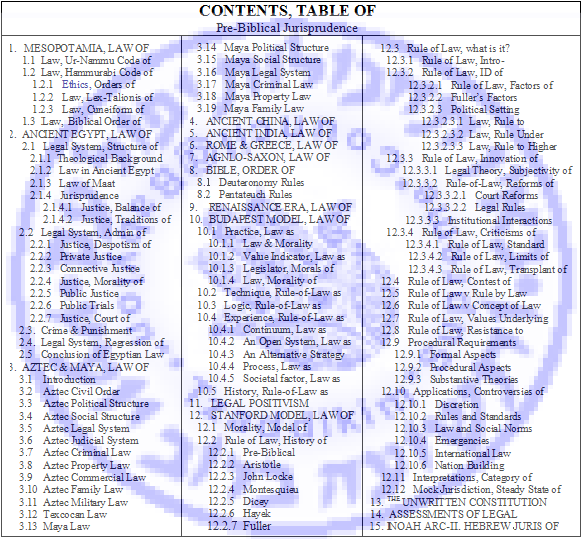



Editorials
Click #
Audio
Click
pdf #



The Global Pedagogy J.
1st & 2nd Ed. Exodus 2021
3rd Ed. Exodus 2026
ISSN:1742-
ISSN:1740-



- #274. If any one hire a skilled artizan, he shall pay as wages of the five gerahs, as wages of the potter five gerahs, of a tailor five gerahs, of gerahs, of a ropemaker four gerahs, of gerahs, of a mason gerahs per day.
- #275. If any one hire a ferryboat, he pays 3 gerahs/day.
- #276. If he hire a freight-
boat, he pays 2.5 gerahs/day. - #277. If any one hire a ship of sixty gur, he shall pay one-
sixth of a shekel in money as its hire per day. - #278. If any one buy a male or female slave, and before a month has elapsed the benu-
disease be developed, he shall return slave to seller, & receive paid money. - #279. If any one buy a male or female slave, and a third party claim it, the seller is liable for the claim.
- #280. If while in a foreign country a man buy a male or female slave belonging to another of his own country; if when he return home the owner of the male or female slave recognize it: if the male or female slave be a native of the country, he shall give them back with no money.
- #281. If they are from another country, the buyer shall declare the amount of money paid to a merchant, to keep slave.
- #282. If a slave says to his master: You are not my master, if they convict him his master shall cut off his ear <>



Notary Public: Editorial Note
This page of R&D can be seen on html format
as well as hard copy print. It can not been seen on
pdf format, due to soft limits of imaging function!
IQ-
Notary Public: Editorial Note
This page of R&D can be seen on html format
as well as hard copy print. It can not been seen on
pdf format, due to soft limits of imaging function!
IQ-
Darling Buds-
The Global Pedagogy Journal Exodus 2021-
Darling Buds-
The Global Pedagogy Journal Exodus 2021-
Darling Buds-
https://site.eu/?aff=juTNcC;
@ Jerusalem Mt.Temple
Void Rule-